DECLARATION OF INTENT
“It is not my intention to persuade or dissuade anyone with regards to marriage.”
That was the way I planned to start this post. But I feel that it would be misleading to lead with that statement. To even think that I can persuade anyone or dissuade them from anything would be equally dishonest as attempting it. People will do what they will to do. People who use their divinely innate will-power to enable some people to lord over others are perhaps using a very low level of personally channeled will, but they are nonetheless using will-power to allow for a certain set of circumstances to prevail in the world. In many instances those who typically demonstrate weak will with regards to major and minor life decisions even share the same titles or labels as those who exercise will-power more firmly, more thoughtfully. They share space and time with others who identify as fighters for the cause of freedom. Many find it popular to designate themselves as Libertarian, or Anarchist these days. But the real difference can be seen in terms of consistency and target. There are those who make showy demonstrations of will-power on specifically ordered occasions where the greater group deems such displays appropriate. This occurs with a type of consistency in regularly scheduled events that serve as safety valves to preserve the status quo like political rallies, testimony meetings, etc. But our blinding hypocrisy shines through when vocalization impresses us with a false sense of accomplishment, and when physical action is directed from shallow grass-roots committees, only ever towards the wrong targets.
Why am I talking about the fight for freedom on global, national, and local levels after premising my remarks with an allusion to marriage? Because the illusion, or mirage that we call marriage has everything to do with the fight for freedom on a personal, local, regional, and global scale. So instead of leading with a negative declaration, let me rather state clearly what my intentions are in the affirmative. In the absence of will power, the most complete collection of virtues and talents is wholly worthless. So, I will, with my writing here, encourage men and women to use their personal supply of divine will-power consciously. That in doing this they may multiply and replenish their personal will, which is their personal portion of spirit, that they may build their spirit-bodies stronger and stronger still, till that increase develops a firm resolve within themselves to embody Christ qualities. These Christ qualities, like spiritual muscle, will enable personal resolve to transcend selfishness and crash through the partitioning walls that divide members of the human race like so many 6x6x6 office cubicles in this art-official reality. Only once this is accomplished can we say that we have lived up to our covenants to “always remember Him.” Cell walls becoming seen for the permeable membranes they truly are, it will be easy in that day for us to join hands and literally re-member the whole Body of Christ which is to rise up in power and great glory, free at last. Awaken. Remain vigilant. Nobody wants to miss out on the wedding celebration of the Bride Groom.
FAMILY HISTORY AND PRE-HISTORY, EXISTENCE AND PRE-EXISTENCE
family (n.)
Early 15c., “servants of a household,” from Latin familia “family servants, domestics collectively, the servants in a household,” thus also the estate and property, including members, of a household. Abstract noun formed from famulus “servant, slave,” which is of unknown origin. Derivatives of famulus include famula “serving woman, maid,” famulanter “in the manner of a servant,” famulitas “servitude,”
The family is said to be the fundamental unit of society. So, if society is disjointed, corrupt, oppressive, and iniquitous, is it then the fault of the family? What family? Which family? Who is this “Royal Family” who captivates the attention of the masses like Princess Die, or Prince Will–I–Am? What are we even talking about when we use this term “The Family”? The much used phrase has become as arbitrary and ironic by this point as the official titles of those who use it the most in their rhetoric today. Catholic Fathers are not fathers at all, in any real role, to anybody, not biologically nor spiritually speaking. But they find that people of the world listen when they speak about the sanctity of “The Family”. Political personas amplify their popularity through proclaiming themselves protectors of “Family Values”. And they amass precious photo-ops through tactics like “baby kissing.” The group which lead the LDS people are called “The Brethren”, but it is unclear how, and on what levels they relate to their followers. If we are all brothers and sisters in Christ then why the distinction, when did it begin to be made, and what does it mean for “The Family”? To their credit, “The Brethren” have tried to be as clear as possible, within the bounds that the Legislative Branch of the U.S. Government has set, about what they mean when they say, “The Family.”
In the first few lines of The Family: A Proclamation to the World, we have The Family being de-fined (stripped of its finery) and obliged to pledge allegiance to The World. The order of this New World of Earthly Existence is discussed in this document as if it were patterned after the Old World where we lived during our “pre-existent” stage with The Creator. At this point “The Brethren” evoke “The Father”. “In the pre-mortal realm,” they say, “…spirit sons and daughters knew and worshipped God as their Eternal Father…” It would seem that here we have found an unmistakably clear mental snapshot which would constitute a pre-mortal portrait of “The Family.” But, here come the selling points (or we should say sealing points). By the end of that same paragraph we are no longer talking about “The Family” but “families”. What on earth has happened to the Divine Family we enjoyed while enjoined in heaven? Did the War in Heaven culminate in a Big Bang, some kind of nuclear blast that destroyed the Divine Family and resulted in a supposedly more favorable dispersion of billions of nuclear families scattered about the universe? Obviously that scenario is not totally accurate. If it were then there would be no need to reorganize single individuals into traditional family units. Nuclear families existing eternally or even naturally as the result of some divine decree or pre-existential action, even an inadvertent one, would eliminate the search amongst males and females of planet Earth to find an adequate and appropriate helpmate. Can “traditional family values” be rightly called an extension or expansion of our family of origin in heaven above?
Notice there is no mention of a Heavenly Mother in the Proclamation to the World or anywhere else in Mormon or other Christian accounts of our pre-mortal existence for that matter. So we can not establish any doctrinal basis for the nuclear family as an eternal order from before the foundations of the world. There do exist sources which take one further back, and cover with more depth pre-mortal and pre-existential states, but they are not to be had inside correlated Christianity. The reality of what occurred before we were physically born into this world is more multifaceted in its complexity, yet much less complicated than the euphemistic reports we have received. It will become especially clear if we are willing to consider exactly where we end up upon withdrawing from the pre-mortal realm into physical existence, but immediately before being welcomed into the world. The conspicuous absence of a Mother in Heaven from Christian theology has a simple and even obvious explanation. But it is not one that most people are prepared to hear, understand, or accept. No, it does not mean that the early Mormon view of a polygynous paternal God is entirely accurate. But, neither does it support the monotheistic idea of a monogamous masculine deity, solar and solo, seated in his heavenly throne. Are we to picture Heavenly Father as a perfect but single parent? No, this would completely contradict statements made in the Proclamation let alone nature’s way. But neither need we assume that it was ever necessary to break up the Family of God into mini-monogamous models? Do such models accurately reflect that pre-mortal portrait of the Divine Family when gathered as one? Is it truthful to say that such flawed families as we have had here since primitive times up to the current day represent an unbroken continuation of that heavenly configuration which was abandoned at some point in our Earthly history?
The Pearl of Great Price gives descriptions of the Fall of Mankind as well as the rise of Secret Combinations. Secret Combinations are Secret Societies on their outermost and not so secret levels. But Secret Combinations have inner workings that are much more fundamental and therefore much more likely to be overlooked, remaining a secret to us. We make the common mistake of assuming ourselves innocent inasmuch as we are unaware of any affiliation or involvement on our part within a Secret Combination. As far as we know, we have not agreed to any binding contract which was authored by and tailors to the terms of Satan. Any time any two things are combined in any degree of unconsciousness a Secret Combination is formed. Once this happens, the only way to undo a Secret Combination is to expose it to the light of consciousness – to transform the Secret Combination into an Open Combination. The plight of the Nephites in the Book of Mormon (3 Nephi 4-7) shows us that we can imprison, convert, or kill every last member of a Secret Society and think we have uprooted the oath-bound bands once and for all, but as long as the basic structures of Church and State remain intact they will in a very short time begin to combine or conspire in the same secret manner to do evil. The secret is not one which is so much kept by so-called insiders of these types of groups; rather the secret is kept from the minds of any and all working within the machinations of Church and State. This is the case no matter how base or pure their intentions may appear. In fact, the more naïve one is, and the more convinced one is of his or her own personal righteousness based on public performance of civic and or religious duty, the more deceived and dangerous one becomes in the Secret Combination.
But all of that is only on the most superficial levels. The real roots of Secret Combinations go much deeper, almost as deep as the foundations of the Holy Family. In order to transmute the Secret Combinations that beset us into Open Combinations that liberate us, we will have to go through the same process of repentance that our First Parents went through to be redeemed from The Fall. It all began with Mom & Dad, and just as they “made all things known unto their sons and their daughters” (Moses 5:12), so we will have to look to Adam & Eve for some “spiritual sex education” if we want to know anything of the Plan of Redemption. In the books of the Pearl of Great Price, Adam and Eve are presented as both literal and figurative parents of the human race. When taken as a literal symbol we can clearly see how the DNA of Adam and of Eve is literally within us all – that the self expression of that DNA is made manifest in myriad ways. When understood on more subtle layers of symbolism we ironically see even less difference between our first parents and us, their offspring, and we come to consider ourselves, men and women, as Adams and Eves respectively. The word אדם ‘adam’ literally means ‘human’ in Hebrew. The name ‘Eve’ in Hebrew is pronounced – Havah, and written – חַוָּה. It derives from the Hebrew verb חוה meaning ‘to breathe’, and is related to the verb חיה (hayah) ‘to live’. It has been noted and discussed at length on this blog that ר֫וּחַ – ruach, the Hebrew word for ‘breath’ is translated as ‘spirit’ in Christian scripture, and that it also corresponds with the concept of a Heavenly Mother since it is always referred to in feminine form even when used with the definite article to mean Holy Spirit (הקודש ר֫וּחַ – ruach ha-kodesh), a vital member of the Godhead. When the Group God – Elohim (literally powers, or deities) creates Adam they then put into him the “breath of life.” He is now, as we would say, a living, breathing soul. The Dual Soul grouping of ‘Adam & Eve’ should be read in a semi-semitic mind set, from right to left to communicate the idea of Living Man.
Once we put these two names side by side the plan and purpose of our existence begins to reveal its self more fully to us. In a post on ldswomenofgod.com there is a brief but beautiful breakdown of the significance of each of the Hebrew letters in the names of Adam and Eve. But it lacks the maturity of a Kabbalistic expounding. So, not surprisingly Heavenly Mother is again missing in action. Since Adam & Eve’s offspring (aka Living Man) comes from the Father through the Mother of All Living, both man and woman share great responsibility. We will have to get a little more detailed than ldswomenofgod with this literal letter by letter analysis. The first letter in the name Adam is Aleph א. Aleph signifies the Father from whose presence we have left. Then comes Dalet ד, representing broken mankind, or a poor man. Dalet can also signify an open door flap on a tent and is the doorway through which we pass from immortality into physicality. Finally Mem ם, represents water. These last two letters in Adam’s name form the Hebrew word for blood, signifying the fact that, cut off from the Father, man becomes mortal. Reading in the Hebrew fashion from right to left then, Adam means: leaving the presence of God and all of mankind coming down to the earth to live as mortal beings. 2 Nephi 2:25 tells us that:
“Adam fell that men might be; and men are, that they might have joy.”
To “have joy” or to “delight in” when used intransitively in many of the Romance Languages, like Spanish, Portuguese, and French, means to orgasm. Eden עדן is a Hebrew word that means “pleasure, bliss, ecstasy.” To be in Eden is to be in ecstasy. All those nerves, all those ganglia of the 3 nervous systems unite in the sexual organs, and when the man and woman unite, all those nervous systems are ignited. If we include the penile duct we have a total of 4 rivers with many tributaries through which, not only the waters or bodily fluids symbolized by Mem may flow, but also surges of electric, ecstatic, Edenic energy while the Garden of God flourishes. This is in keeping with Genesis 2:10 which states that:
“a river went out of Eden to water the garden; and from thence it was parted, and became into four heads.”
Expulsion from the Father’s presence should not be premature. Neither must it be necessarily viewed as a negative thing. This after all comprises only the beginning part of the work of the Father. First spiritual energy is built up within the Father. Next that spiritual energy is released in physical form via carrier liquids and conductive channels. Following the sacred formula set forth in D&C 29:32, the Group God – Elohim creates:
“First spiritual, secondly temporal,”
God designates this as the beginning of His work. And here the baton gets passed to His “better half” where the work of the Mother commences. Her work is on the receptive end, and hence will be a symmetrical reflection of the Work of the Father. Verse 32 continues:
“and again, first temporal, and secondly spiritual, which is the last of my work—”
Another type of Eden welcomes and makes a home for the traveling soul who is on his or her way to the Lone & Dreary World of external experience. This Garden is more dimensionally dense than the last, more watery, but it is very comfortable. It will remain reasonably so up until – like the soul’s bout of sudden excitement at the outbreak of the War in Heaven – pressure builds and the pattern repeats, sending the heroic wayfarer on to the next leg of the journey. A mirror image starts to emerge as the Divine Plan progresses by the wisdom, and willingness of Eve.
Her Hebrew name, Havah חוה, picks up where Adam left off. The letter Chet ח, is packed with symbolism, much of which is missed in the brief post from ldswomenofgod.com. The author at that blog says that Chet represents a sacred or holy enclosure. She of course associates that with the idea of the Holy of Holies of The Temple, but only as seen within a Church context. In addition to her summation, I would like to offer some insight that addresses the role of Heavenly Mother and highlights the value of women. In the most reverent manner possible, may I boldly suggest that LDS women of God humbly recognize their own divinity, and remember that the body is the Temple of the Lord. In the classical Hebrew script Chet is constructed of the preceding two letters in the Hebrew alphabet, Vav and Zayin, joined at the top with a connecting line that resembles a yoke. Young LDS men and women have been repeatedly told by Church clergy to find a partner with whom they can be “equally yoked”. Yokes can be tools for combining efforts, and when used properly they can assist us in keeping those combined efforts open and clear of any secret combination. A yoke is a connection between two things so that they move and work together. Since the gematrical sum of the letters Vav and Zayin equals the same value as the Hebrew word for love (), we can see that the essential nature of this “moving and working together” is that of loving, even physical love making.
But all too many LDS marriages, although the wedding ceremony was performed in a beautiful building, are not taken on by both parties as an egalitarian yoke, but rather as a disjointed and cruel joke where one person shoulders all the burden. Most often the man supposes that by virtue of holding down a steady Babylonian job, he is entitled to shirk the emotional work required in family life – this, despite “The Brethren’s Proclamation” which suggests that sacred responsibilities be shared. Elohim’s commandments to Adam & Eve (Man & Woman) are even more explicitly against the division of labor, for therein lies the beginning stages of the division of the family. Nevertheless the unrighteous LDS man “holds the priesthood” over his wife’s head, and excuses all kinds of abuse on his part, while expecting her to be the more spiritually attuned one in the relationship. After all, it has been said on numerous occasions from LDS pulpits world-wide that women are naturally more spiritual than men. This is a patronizing cop-out that causes the hearts of many of the “fair daughters of this people” to die “pierced with deep wounds” as Jacob laments in Jacob, chapter 2.
Vav and Zayin equally yoked in Chet form a gateway. Since the letter Vav represents the yashar (light that descends from God the Father) and Zayin represents the chozer (light that ascends or returns to God the Father), some of the Jewish mystics consider Chet to be the doorway of light from heaven. And it should be apparent to anyone who is a parent that the light is reflected back out of the woman in the form of children who are “an heritage unto the Lord, and the fruit of the womb is his reward” as it says in Psalm 127:3. In our examination of the symbolic name/nature of Eve, we are honoring Chet as a symbol of the physical gateway through which all souls must pass to enter the Holy of Holies and eventually move into clay tabernacles of their own, for Eve is the Mother of All Living. The physical attributes of the woman are to be revered as sacred, not shrouded in secrecy; lest we let the Devil slip in between Adam & Eve and slyly shame them into a Secret Combination.
The second letter in Havah’s blessed name is Vav ו . Vav comes from a pictogram representing a stake or nail, and everywhere it shows up in Hebrew scripture it plays the role of connector. The first place we find it is in Genesis 1:1 where it connects the words “heaven” and “earth” in the story of creation. This placement is very appropriate since as our “equally yoked” Heavenly Parents told us in D&C 29:32 their co-creative and procreative work goes back and forth from spiritual to physical, then physical to spiritual in one eternal round. When we tap into this back n’ forth vibration we feel a sense of timelessness. And it is out of that infinite moment that we extract the souls of newborn children. Those souls get inserted by the Fat-Her into the Mother where they grow in her belly to over thousands of times the size of their initial gamete vehicles, and even hundreds of times the size of the zygote body. The word zygote actually comes from the Greek ζυγωτός zygōtos “joined” or “yoked”. Another notable and oversized Vav marks the center of the entire Torah (Leviticus 11:42). This spot in the text is known as the Belly of the Torah, not only because it is at the center point of the whole body of scripture, but also because it happens to occur in the word gachon, meaning “belly.” The oversized Vav at the Belly of the Torah makes a strong symbolic connection to the oversized belly of a pregnant priestess.
As pregnancy progresses through the three trimesters, so the three letter name of Eva חוה progresses to the final character – Hei ה . Hei is pronounced exactly like the English interjection “Hey!” and used by itself it has a similar meaning of “look” or “behold!”
According to early Jewish prophets Hei represents the divine breath, referring to the sound of the letter Hei – the outbreathing of Spirit. A prefixive Hei (or we might say the pre-existential Hei) functions as the definite article in Hebrew appointing the Children of The Most High to specific situations, whereas a suffixive Hei at the end of a noun “feminizes” it or allows it to be “fruitful” and reproductive. Remember how I said that Dalet represented a broken and poor man, but also the open door flap of a tent? Well, Hei ה is formed from Dalet ד and Yod י which looks like a comma suspended in midair and symbolizes an open hand. An angular open flap with an open hand should be a familiar grouping of imagery for Mormons who have been initiated and endowed in an LDS Temple. While the author of the post at ldswomenofgod.com claims that Vav stands for the veil of the temple, when in fact Vav only has the connotation of a connector and never that of a divider, still, the analogy works; perhaps better than she might imagine. For, approaching the spiritual side of the name of Mother Eva, we have come full circle in the First-Last/Last-First equation of F–L/F–Lment in God’s Eternal Plan. It is said that the lines of the letter Hei paint a picture of returning to God by means of the transforming power of the Spirit.
The order of events in the Book of Moses in the Pearl of Great Price sheds much light on man’s beginnings, both in terms of a historical timeline for mankind’s giant leaps, and the smaller steps of a human being’s biological beginnings and individual lifeline. It is however important to realize that the Fall of Man involves a fall in frequency and does not begin at the point of their expulsion from the Garden of Eden, but long before, in higher, heavenly dimensions. A stationary observer would see great geological changes to the face of the earth over time, but these of course stem from forces set in motion behind the scenes as it were. The temporal advancement of the ages alone can not account for the disappearance of Eden any more than Darwin’s theory of Evolution can fully account for the emergence of humans. Adam, whether spoken of in his pre-mortal role as Michael the Archangel who bravely cast Satan down from the heavenly realms, or in his role as the First Man created from the dust of the earth, he is the same essential being. Truth is unchanging in that what is true for God’s children prior to mortality is true for God’s sons and daughters in every succeeding stage of existence. The half-way point for sojourning consciousness between heavenly and earthly stations is its playful time in the Garden of Eden. The womb is also technically part of that stay in the Kinder-Garden for all children of God where they rest and literally gather themselves, reviewing their divine mission callings before leaving the presence of the Holy One and fully entering the forgetful world of form.
Once gathered closely in one pre-existential heavenly huddle of spirituous forms, they felt sure, suspended in time, and undisturbed until a sudden war began to divide them and launch each individual headlong into the coming reality. What can seem a gradual paradisiacal process of condescension and gestation from one perspective, does at some point reach an abrupt transition. The mixing of eternal and earthly elements is full of fleeting sensations and can be somewhat confusing. What has the developing baby in the womb done to deserve being thrust from such weightlessness and convenience into a pressing sense of uncertainty? What parties have come together to decide the child’s fate, and where was he when this grand council was held? It is the same two Titans who clashed when, as a divine spark, he rode alongside millions of his brave brethren and sisters, spirt siblings – the hosts of heaven upon an armada of spermatozoa pushing out from Netzach in Victory through Hod – the final sphere of the “purely spiritual” realms which symbolizes Splendor, a spilling of light.
Biblical Adam is usually styled as Ha-Rishon “the first”. But in Kabbalah, Adam Ha-Kadmoni “the original” is indeed the first of the comprehensive Five spiritual Worlds in creation. Adam’s pre-mortal function above is distinguished from biblical Adam below in the flesh, where he included within himself all future human souls before partaking of the fruit of the Tree of Knowledge of Good and Evil. The divine attributes of Adam’s former glory are never left behind; he carries the specific divine will and divine plan for subsequent creation within his pouch. He is like a character in the old movies that packs his most prized possessions into a sack tied to the end of a stick and sets out from home to embark on the adventure of a lifetime. Adam Kadmon (Original Man) is divine light without vessels, including all subsequent creation only in potential. This exalted anthropomorphism denotes that man is both the theocentric purpose of future creation, and the anthropocentric embodiment of the divine manifestations on high. These are some of the plain and precious truths which were had among the ancient Jews but were occulted long before Yeshua’s arrival and further muddied after his departure when he charged his apostles with delivering those plain and precious truths to the gentiles. I know of no plainer way to explain these “precious jewels” than to refer one to the ancient Biblical origins of sacred oaths and their association in ancient Semitic culture with the “precious jewels” of a man’s testes. From “testes” comes our word, “testify”. But who can testify truthfully of the Original Man, the Ancient of Days, without First Being acquainted with Him?
SURGICALLY SEVERING THE BONDS OF SATAN’S SHAMILY
If we want to sever our bonds with the Shamily of Satan we must first look at Satan’s genealogy. You will remember how the author at ldswomenofgod.com postulated that the Hebrew letter Vav stood for the Veil of the Temple. Of course this Line of Reasoning in the Temple of Reason is understandable. What else but a veil would a corralled Mormon mind correlate with this mid-way point between the physical and the spiritual steps which bring about the Last phase of Gods’ Work and Glory? But, as we have seen, Vav is the sign of “a nail”, and it serves us as a connector or not at all.  What needs to be connected in order for The Family of God to continue? The glorious and glaringly obvious answer to this question lies in spiritual DNA. We have already delved into the “spiritual sex education” teachings of our First Parents, and it is vital knowledge to understand the wisdom of “spiritual sex” since by no other means, and in no other place than those temples pre-ordained by God can spiritual DNA (our divine heritage) be passed along through all generations of time. It may help to think of the Vav not merely as a nail but as a spiritually charged conductor for the purposes of creating a complete circuit between two points, two energy vectors. In even more tangible terms, Vav is a Valve. When God first created the “gene-rations” of the heavens and the earth, the word toldot (תולדות) is used (Gen. 2:4). This refers to created order before the sin and fall of Adam. After the fall of Adam, however, the word is spelled differently in the Hebrew text, with a missing letter Vav, like so – תלדות. Thereafter, each time the phrase, “these are the generations of” occurs in the Scriptures (a formulaic way of enumerating the gene-rations of the heads of families) the word is spelled defectively, with the Vav (ו) missing. The connection was “lost.” However, when we come to Ruth 4:18 the phrase: “These are the generations of Perez” is spelled with the missing Vav restored!
In all of Jewish scripture, the only two places where we see the restored spelling is in Genesis 2:4 and Ruth 4:18, which leads our minds to ask what connection there might be between the creation of the heavens and the earth, the fall of mankind, and the creation of the family line of Perez? As a prefix Vav is used to function the same as the English word ‘and’. AND reversed spells DNA. In modern Hebrew the word ‘and’ would be rendered as a straight line. It was through this line (ו) of Perez that Jesus was born, as many may know. Jesus is important, but Christ is crucial. Christ has the central role in Gods’ plan, and Christ is a concept that transcends, or breaks through. What is truly important is to acknowledge that the name Perez (פרץ) means “breach” (from paratz, meaning “to break through”). What does God need to “break through” in order to redeem his children? God is literally breaking through, and breaking up the families of fallen mankind so that he may restore the Divine Family here on Earth. Jesus Christ himself made it clear that he came to break up the imposter families into which we were all born.
“Suppose ye that I am come to give peace on earth? I tell you, Nay; but rather division: For from henceforth there shall be five in one house divided, three against two, and two against three.” – Luke 12:51-52
Of course the exact ratio of “three against two, and two against three” is referring to a five dimensional “household” of existence and being. We cling to and are tied to these three familiar dimensions and set ourselves at odds with the two higher dimensions of Heavenly Father and Heavenly Mother. But the enmity which exists between the 3rd dimension and the next two above us is not the only level of meaning which we should extract from this 3/5ths ratio. It has very real physical effects that trickle down like acid rain into this earthly existence. You will recall that not too long ago in the history of this wicked world it was decided by the American congress that people of African ancestry were only 3/5ths of a human being. We would be foolish not to pay attention to the more literal levels of Jesus’ teachings here along with the deeper symbolism. In Matt. 10:35-37 he declares:
“For I am come to set a man at variance against his father, and the daughter against her mother, and the daughter in law against her mother in law.
And a man’s foes shall be they of his own household.
He that loveth father or mother more than me is not worthy of me: and he that loveth son or daughter more than me is not worthy of me.”
How can someone’s enemy be of his own household, and yet he love his biological connections more than God? We can not afford to discount the importance of Jesus’ “hard sayings” as so many do with their pick-and-choose approach. If we do, we pay a high price indeed, for ignoring the Pearl of Great Price. Returning to the book of scripture by that same title, we read about the period immediately following the time known as the Fall when sin entered the world. Moses 5:3 tells us:
And from that time forth, the sons and daughters of Adam began to divide two and two in the land, and to till the land, and to tend flocks, and they also begat sons and daughters.
Then later on in Moses 5:13 we read:
And they loved Satan more than God. And men began from that time forth to be carnal, sensual, and devilish.
If we can not love our own flesh and blood more than God and still be counted worthy, then obviously loving Satan more than God would bring about disastrous results for our souls. At the same time we are commanded to love all men, even to love our enemies. Could it be that The Enemy (singular) goes about undetected among our households while we deem this or that group of fellow beings as enemies (plural)? Surely, as the scripture says, “an enemy hath done this” (Matt. 13:28) – but how? Ezra Taft Benson seems to place all the blame with certain communist “insiders”. But religious and political affiliation with any one particular lineage or set of cultural comrades to the exclusion of those with doctrinal differences creates a rift which more accurately places the power for evil with “outsiders”. Scripture never attributes power to any enemy without, only the enemy within the gates. When Jesus unequivocally asserts that a man’s familial fetters are those with which the enemy binds him, is he saying that we ought not to love those to whom we are linked by physical DNA chains? No, he says they are our enemies, and in the Sermon on the Mount Jesus made the bold rally cry to “Love your enemies!” Enemies are, after all, only fellow slaves who are scared of revolution. The Enemy which God warns us of in scripture is non-human. But it is clear that we never should, nor could we in truth ever really love our fellow beings with a love greater than that which we have been able to muster for God and God’s Family.
The First Family does not reside in the White House. The real Royal Family is not to be found walking the halls of Buckingham Palace. The First Family is the Heavenly Family which was made during the first stage of creation related in Genesis 1. This was an immaterial, spiritual creation. Then in Genesis 2 we find the account of the second stage of creation which was accomplished temporally. Most have supposed the latter to be a redundant, only somewhat more detailed version of the same events reported in the previous chapter. But this is not the case. For clarity on this matter let us review the Group God – Elohim’s creative formula revealed in D&C 29:31-33.
“For by the power of my Spirit created I them; yea, all things both spiritual and temporal—First spiritual, secondly temporal, and again, first temporal, and secondly spiritual, which is the last of my work—”
See, in Genesis chapter 1 we read about how Elohim first “made” all things, and in Gensis chapter 2 we are told how Elohim later “formed” all things. Hebrew word #6213 in Strong’s Concordance is עָשָׂה `asah – to do, accomplish, make. Hebrew word #3335 is יָצַר yatsar –to form, fashion, frame. During the whole first chapter the earth was “tohu bohu” – “without form, and void” (Genesis 1:2). But in dimensions beyond what we now typically experience in our daily routine, all plants, then all animals, and finally all men and women (not just Adam and Eve) were created in spirit. It says, “Let us make man,” and this was done in the “image of God” on the 6th Day. But then in Genesis 2:5 after God has rested from their labors it says that “there was not a man to till the ground” until verse 7 when God forms Adam out of clay, or dust of the earth that had been moistened by mist. From there the sequence forms a mirror image of the first half of creation starting with plants, then animals, and finally God’s crowning creation – woman.
The corrupt fruits of the Shamily Tree of Satan start to make themselves visibly manifest with those sons and daughters of Adam & Eve who, following the monogamous model, “began to divide two and two in the land” (Moses 5:3). They divided themselves according to the monogamous model and proceeded to “till the land, and to tend flocks, and they also begat sons and daughters.” All things were made known unto them by their First Parents who heard the voice of the Lord speaking to them “from the direction of Eden” (Moses 5:4) although they could no longer see the Lord. The Only Begotten was preached unto all their spirits directly via the Holy Spirit. But Satan, being the Lord of External Reality, “came among them” (Moses 5:13). He told them that seeing was believing, that to be-living one must acquire, consume, and horde a certain amount of physical stuff. A man’s life consisteth not in the abundance of the things which he possesseth (Luke 12:15). All mankind had been created as immaterial spirits in Heaven first and foremost, but for most this temporal reality became so tantalizing that they soon forgot themselves in a game of gluttony.
In order to play this game a lot of food would be necessary. To produce mass amounts of foodstuffs huge areas of land would need to be tilled. Tilling land is what fallen man does best. Even the sacred geometrical spirit structures of pure light that are commonly referred to as auras today, once mankind had fallen they took on a shape that resembled something like a tuber with a long tap root which creates ruts, “tilling” the energetic layers in the aura of the earth as fallen man moves to and fro. This shape may be what the blind man, after having been touched for the first time by Jesus beheld when he saw “men as trees, walking” (Mark 8:24). Such a spiritual attachment to our auras is probably also akin to the Chains of Hell which confine mankind to a similar fate as Cain through Satan. But as he filled up on starches the connection between early man’s spirit and physical body suffered greatly making him weaker and progressively more limited in his powers. It would take increasingly larger labor forces to upkeep an agricultural attempt at subduing man’s environment which seemed to have turned so hostile since the Fall. Stubborn and unwilling to repent just yet, civilizations concocted ever more elaborate methods of coping, each of them relying heavily on the arm of flesh, and leaning to their own understanding with a goal to create surplus goods.
Those who had made special and specific covenants with Satan formed an elite intelligentsia. Everyone else willingly aligned themselves behind these ancient men of renown to play the dependent role of subjects and slaves. Each side inducted the other into a Secret Combination. The only way out of this Secret Combination is to refuse to take sides and rather de-side one’s own fate. But man’s willful rebellion led him to invent an imaginary scenario in which he could convince himself that he were forced to decide between the lesser of two evils. This is in the greater reality nothing but spiritual sloth, for to de-cide between bad and worse is to commit deicide (the act of killing God). Being well aware of the divine flame within temporal mankind due to that aspect of their beings which had been created all together in the same day during the first half of creation, but vowing to keep it a secret from the masses of earth elements known as carnal man – one third of creation (the physical portion) was made to submit to the tyranny of one third of the Hosts of Heaven (spiritual creation) who had rebelled against the other two thirds, that is, against the God from whom they were made, both the God of Heaven and Earth.
From scriptural stories of the War in Heaven we learn that Lucifer led one third of the Hosts of Heaven after him. People have supposed this to be a case of one individual lying to others and using flattery or trickery to convert them to his scheme. But since every individual that has existed, does now, or ever will exist upon this planet was spiritually created at the same exact moment, we each knew everything that anyone else knew, and there was no way anyone could employ trickery against another. Lucifer does not represent an individual so much as the concept of individualism, but not a true individualism, rather a gross misunderstanding of it. If Luciferianism is misused individualism, then Satanism is misinterpreted collectivism. Lucifer says: “Surely I will do it!” (Moses 4:1) and the conglomerate of souls known as Satan cry out with one voice: “All hail the King!” This chant is a morphed echo which has come down to us through a mischievous game of Telestial Telephone from the Meridian of Time when it was originally shouted thusly: “All nail the King! Crucify him, crucify him!” (Luke 23:18-21). The two groups (the leaders and the led) are both blind and together form one Secret Combination of liars and legions. It allows God’s spirit children to keep a comfortable distance while still extracting work and certain benefits from their physical bodily counterparts. It allows for limited liability on the part of the mob. The lustful rush of power remains carefully reserved in the hands of the self-endangering crowd to be released (like Barabbas) only in murderous moments (like the day of the carnivorous and cannibalistic feast in Luke 23:17-19). No, not one soul will be lost, but many. Both parties in this conspiracy are guilty of working iniquity/inequality.
We all were, and still are, Divine Consciousness, divided into diverse bodies only for the purposes of growth and learning. As children of the Most High we are faced with the difficult decision of sacrifice of self versus sacrifice of others. But this is a tricky illusion because, being made from the self-same substance of Holy Spirit meant that, should we choose the seemingly safe route of sending another to sacrifice Himself for the rest of us, we will eventually be exposed and expelled as hypocrites for denying the Holy Spirit out of which we and Him were and are made essentially one. The Devil uses the appeal of a one-man sacrificial lamb system to give our minds the sense that security, and ultimately salvation can be bought if the Price is Right. Regardless of if the Prince is Righteous or not, he will always have his whipping boy, or so the thinking goes. False deities and their devotees in ancient times called this the doctrine of the scapegoat. Latter-day false gods call themselves corporate entities, and refer to this practice as “externalization”. From sheep to sheeple the progression of work has gotten progressively worse. Human history is the glorified gore of human sacrifice. Even though the word corporation comes from corpus, meaning body, corporate entities are not corporeal. These are entities which were afraid to take upon themselves the “far more exceeding and eternal weight of glory” (D&C 132:16) of a physical body, but who nevertheless are composed of strong natural desires towards the fulfillment that only comes through a union of spirit and flesh. The blood, sweat, and tears required for an individual’s redemption are therefore always cast by these entities upon somebody who actually has a body of flesh and blood. Adam & Eve chose to go through the pains and suffering and eventually rejoiced in their redemption, but many of their children rejected that path. Their spirits chose to remain aloof from their bodies as much as it were in their control – a deadly misuse of free will.
Those of us who truly take on physical bodies, take upon us the role of sacrificial lamb and savior. We take upon us the Name of Christ. That third part of the Hosts of Heaven which knows not the mind of God devised a plan which allowed them to bury their portion of spirit in earthen bodies, never to be used or risked. Their reasoning was that by keeping their t-a-l-e-n-t l-a-t-e-n-t not a single soul would be lost. What we really mean when we tell ourselves this lie is that we will not let go of our sense of singleness, that no “single” soul will be shared in this world, except under tightly controlled circumstances (man-made marriage). So the plan of exclusivity and externalization ensures that all are lost, becoming Sons of Perdition. The thing about Sons of Perdition is that they refuse to admit that they are lost. Deep inside the truth is known, and this is why the subject of Sons of Perdition is such a secret obsession among Elders in the Church of Jesus Christ of Lattter-Day Saints. Under the law the Holy Spirit in man is down-played and denied. If followed to its law-gical end we will be deposited into outer-darkness. Holy Spirit is that which connects individual and collective in an Open Combination that reduces the veil of unbelief to little more than a blurry line of scintillating electromagnetic energy which invites us to love and know one another, to know one’s self, know One Self, know Christ, know God.
Now that we have examined the genealogy of Satan’s Shamily we have before us a recent shamily portrait. It is not a pretty picture, though it poses as such. When you see the cheesy smiles, bear in mind that the photographer is Lucifer, the Light Bearer who coaxes them to say “cheese” so that they may keep up the appearance of happiness as he blinds them with flashes of false illumination. All the while he is assuring their ego with interjections of: “Beautiful…what a beautiful family!” This “perfect family” is propped before us all as the model which we must strive to emulate. Satan whispers in our ears as he proposes marriage that is most likely to serve his perverse purposes. We are told that, if we take part in the right rituals, in the right place, with the right person, we “shall be as the Gods”. It is not a family but a famiLIE, having a form of godliness but denying the power thereof through parameters placed by Church & State. Satan’s most current Shamily portrait shows a spiritually dysfunctional group that is nuclear in its physics structure and self-destructive in its nature like a nuclear bomb. It is preferably Christ-Shun in its programming. Each unit is issued license numbers and is a Government-approved, Church-sanctioned, monogamous machine. The machine’s function is to act as a franchised secret combination. In reality it is the inner most sanctum for all sects/sex of the Grand Secret Combination, but it does not know this. In each Husband & Wife’s mind their highest calling is to be Dud & Mum to deactivate & silence the Power of God before it can enter into this world by way of free will.
It is not that there is anything essentially wrong with the union of one man and one woman. Nor is there anything inherently evil about the agrarian lifestyle. The devastating effects arise from the manner in which these things are executed. Man-made marriage, whether in its modern monogamous form, or Paleolithic polygynous pairings, stems from the concept of ownership. Did the idea of owning land lead to the idea of owning people? People were fashioned by Elohim out of the dust of the earth/land, so I don’t think we can make a valid distinction between those two types of ownership. Moses 5:3, as well as famed anthropologist Jared Diamond’s scathing indictment of the agricultural revolution, seem to indicate that the evil and alien devils of ownership over people and place invaded the humanity and its habitat simultaneously. As soon as Satan was cursed to “eat dust” all of his days (ie. to eat away at all earthly creation including human bodies which are composed of the dust of the earth), that devil dug deep into Mother Earth with tenacious talons to obtain gold and silver with which to tempt Her children (For more detail see Moses 4:20, Genesis 3:14, LDS Temple Endowment – The Garden Scene, or read The Devil in the Dust). The “tenacious talons” he used for mining were our early ancestors themselves as they clutched tightly the talents they had received as inheritance from their Lord. The devilish doctrine of “MINE” made for millions of “MINERS” desperately seeking outside of themselves for that which is precious above all else – the Love of God. With a SCARCITY mind-set they set about building one SCARED-CITY full of SCARED-SILLY slaves to the devil and his angels. All it would require to break the spell and put a stop to Satan’s Army would be to shed selfishness and let our inner light so shine before men that work-a-day worldly worriers change into warriors of truth and light. When we see the Army for what it really is, understanding that they Are-Me then the War in Heaven ends and the domino effect will cause the by now long line of tyrants to fall till Christ Consciousness reigns on Earth.
RELATIONSHIPS vs. RELATION-CHIPS
Man-made marriage and agricultural techniques which are not based on a deep respect for nature are a perverted and corrupted compLIEance with the original commandment to multiply and replenish the earth. What is the original sin and what are the resulting transgressions which identify its commission? They are possession and ownership constructs stemming from fear of loss or lack, which itself is a direct result of lack in only one category – lack of faith. The Forbidden Fruit is a Fore-Bitten Fruit. Partaking of it triggers a downward shift in consciousness that dissects and transforms the same outward actions in which we had previously taken part – those which gave us joy and gave God pleasure – into taboos to be avoided at all co$t.
Wendell Berry, whose integrity as an American novelist, poet, environmental activist, and farmer certainly qualifies him even by worldly standards to be a cultural critic of our corrupt customs, says that:
“Marriage, in what is evidently its most popular version, is now on the one hand an intimate ‘relationship’ involving (ideally) two successful careerists in the same bed, and on the other hand a sort of private political system in which rights and interests must be constantly asserted and defended. Marriage, in other words, has now taken the form of divorce: a prolonged and impassioned negotiation, as to how things shall be divided. During their understandably temporary association, the ‘married’ couple will typically consume a large quantity of merchandise and a large portion of each other. The modern household is the place where the consumptive couple do their consuming. Nothing productive is done there. Such work as is done there is done at the expense of the resident couple or family, and to the profit of suppliers of energy and household technology. For entertainment, the inmates consume television or purchase other consumable diversion elsewhere”
This concise expose on the consumptive (lustful) nature of the most modern and up-to-date version of the man-made institution of marriage reminds me of a scripture in the New Testament which addresses the same issues.
“But if ye bite and devour one another, take heed that ye be not consumed one of another.”
– Galatians 5:15
 It seems we are actually chipping away at each other and furthering the fragmentation of society with all these relation-chips in which we are “engaged” instead of being “engaged” in the good cause of Zion as we are invited to do in D&C . Cheesy “engagement” photos are added to Lucifer’s portfolio after being circulated among pleased “family and friends” with invitations to a very exclusive and elitist event which supposedly marks the fulfillment of all righteousness for two young LDS people. Indeed ye may say we ignore the admonition of Paul to:
“Love thy neighbour as thyself”
Paul even goes so far as to say that:
“For all the law is fulfilled in this”
Christ’s apostle warns us against biting, devouring, and consuming one another. Today’s apostate apostles give add-vice more in line with the policy behind the Devil’s sneaky introduction of state marriage licenses. The intent behind any l-i-c-e-n-s-e really is to try to s-i-l-e-n-c-e the still small voice speaking in our hearts. All marriages which are not marriages of the heart are not of God. The heart chakra is seen as a spinning ball of emerald light. Without getting this “green light” marriages do not have the Lord’s approval. Marital links are bound to u-n-t-i-e in as much as they fail to u-n-i-t-e the intellectual with the instinctual in the common ground of the heart chakra, because they have not been sealed by the Holy Spirit of promise. Not many know or care that the marriage license was introduced in the U.S. to prohibit and prevent the reunification of the races, to circumvent the literal gathering of the Tribes of Israel, and thereby encourage racism and spiritual inbreeding. But Satan and all those who are members of his Shamily do care very much if you attempt to make such an important decision such as with whom to join yourself in holy matrimony listening only to your heart. The Lord’s voice as heard by Adam & Eve coming from the direction of Eden, that green garden located in the heartland is supposedly not enough to base such life decisions on it. Mother Eve’s shock and dismay is felt and shared by all those who personally know God. The “Brethren” have come to persuade us to disobey Father and to do the Devil’s bidding in keeping the 12 Tribes separated, scattered, and weak. It is important to Latter-Day Rome to uphold Romantic ideas about marriage. Exactly one month after Valentine’s Day in 1977, apostate apostle Void K. Packer gave a talk entitled Follow the Rule to an audience of marrying age young adults at BYU. Referring back to an earlier quote from the then President, Spencer Kimball, he spoke these words:
“It’s been the policy of the Church—and it’s been spoken on many occasions—that as the gathering of Israel is in Mexico for the Mexicans, in Tonga for the Tongans, in China for the Chinese, and so on, so has been our counsel as it relates to marriage.
We’ve always counseled in the Church for our Mexican members to marry Mexicans, our Japanese members to marry Japanese, our Caucasians to marry Caucasians, our Polynesian members to marry Polynesians. The counsel has been wise. You may say again, “Well, I know of exceptions.” I do, too, and they’ve been very successful marriages. I know some of them. You might even say, “I can show you local Church leaders or perhaps even general leaders who have married out of their race.” I say, “Yes—exceptions.” Then I would remind you of that Relief Society woman’s near-scriptural statement, “We’d like to follow the rule first, and then we’ll take care of the exceptions.”
Geopolitical statements like that rarely, if ever, get recognized by LDS for what they are. There is a growing number of LDS whose banter about “threatened liberties” and “One World Global Government” and “Secret Combinations” and such has grown considerably more fervent in recent years. But even these do err because they are taught by the precepts of men in suits in their places of worship. Their membership in the Secret Combination is a secret to themselves. These patronizing patriots would never question the false traditions of their founding fathers, especially not those dealing with “The Family”. Although the literal gathering of the 12 Tribes is one of their 13 articles of faith, they support a “don’t come to us, we’ll come to you” anti-gathering policy when it comes to their franchised McDonald’s farmed-family plot version of Zion. This is because they are willfully ignorant of and uninterested in the spiritual gathering which requires personal effort on their part to know the Holy One of Israel. It is much more comfortable to snuggle up to their spouses and sleep the deep sleep of the Ten Foolish Virgins. I used to think it harsh when I would read at the end of that parable where the Wise say to the foolish and fuel-less half of the wedding invitees, “Go to them that sell.” But now it makes perfect sense to me. The Foolish Virgins miss the real Wedding Feast of the Bridegroom precisely because they invest their faith in mammon-arranged marriages. In Zion is milk and honey without price, but their faith funds are fully invested in the world of finances and fiancés. They have locked the Seed of Abraham away in a savings vault with the World (Seed) Bank and now they are asking the Wise Virgins for a loan? Just as I can not expect another to magically endow my body with muscle and strength enough to enable me to perform great feats, I can not rely on anyone else but my Lord to light my way in these last days. For he is “the true light that lighteth every man that cometh into the world” (D&C 93:2)
When I say “my Lord” I mean that portion of the Light of Christ that is my own spirit body. The scriptures are surprisingly clear when distinguishing between “The Lord YOUR God” and the One Source which is referred to as “Your God AND My God”. The literal gathering of Israel can not occur without the spiritual gathering and the two coincide with the reconciliation and reunification of both your spirit and physical bodies. This may seem a very foreign concept to many, but that fact in of itself is only evidence of the reality of fallen man’s predicament. It seems foreign because we are strangers still to ourselves. If we make an earnest study of the scriptures we will learn much and see the truth clearly.
“This I say then, Walk in the Spirit, and ye shall not fulfil the lust of the flesh.
For the flesh lusteth against the Spirit, and the Spirit against the flesh: and these are contrary the one to the other: so that ye cannot do the things that ye would.
But if ye be led of the Spirit, ye are not under the law.”
– Galatians 5:16-18
Walking in Spirit should not be a hard concept to accept. After all, in the 21st Century we accept all kinds of invisible forces. We accept radio waves, microwaves, cell-phone transmissions, TV waves, X-rays, ultrasound, and cosmic, and infared radiation without question. Nobody has ever seen or touched any of these things, but they are an article of total faith for everyone, just because science says so. But men and women are stubborn and prefer to remain divided in their psyches, in their houses, in their neighborhoods and as a family. If walking in spirit is so simple in concept, how about in practice? What’s the trick to it? The trick is that there is no trick. Notice that Paul says that if we are led by the Spirit, we are not under the law. What does he mean we are not under the law? Is not spirit bound by the same laws of the universe as we have observed them to be through telescopes and microscopes? I was trained in SS (Sunday School) to think that God reigns Supreme because of his knowledge of and perfect adherence to the laws of nature. How then can anyone be above the law? Here are some quotes from two very different people, both sometimes referred to by the title “Lion in Zion”.
Brigham Young once said:
“If I had forty wives in the United States, they did not know it, and could not substantiate it; neither did I ask any lawyer, judge, or magistrate for them. I live above the law, and so do this people.”
– Journal of Discourses, v. 1, p. 361
He is also quoted as having said:
“I want to live perfectly above the law, and make it my servant instead of my master.”
It is informingly ironic that Brigham should say that if he had forty wives, they did not know it, and could not substantiate it. Marriage after the manner of men, including Mormon marriage is of “no effect” outside of this world. Thus saith the Lord in section 132 of the D&C, so proponents of Mormon marriage should know better than anyone. And, as Brighams unwitting victims of his lawless and loveless marriage contracts can attest, man-made marriages, even whilst in this world, can often be so meaningless that the participants can not substantiate it. It is good that Brigham Young did not ask any lawyer, judge, or magistrate for the women he married, for they never were state property. But if Brigham thought that they belonged to him for “time and all eternity,” then he was no doubt greatly disappointed in the next life where all such vain imaginings fade and all relationships revert back to their natural and eternal state of spiritual sovereignty. In earlier posts I have addressed Brother Brigham in all his iconic yet ironic bravery as well as his bigotry. He was a man. As men all any of us can strive for is balance between the extremes (Heavenly Mother & Father) that combine to make us what and who we are. Is one extreme good while the other is evil? Essentially and literally it is us who determine. The very “constitution” of our beings is “endowed” by our Creator with the “unalienable” Right to Choose. To “Choose the Right” does not mean we never “Choose the Left,” for to place such ridiculous restrictions on children of a Supreme Being would have us going in circles. But the Devil is an alien force that seeks to alienate spirit and flesh from one another. We aid by engaging ourselves in worldly marriage contracts in which two children of God combine and swear and oath to serve Satan as gate keepers between the Heavenly and Earthly realms. They swear to only use the Power of the Creator amongst themselves, never outside of their Secret Combination, and never in any significant quantity or quality.
During an interview in 1973, when asked by the Pharisees, “what do you think about all this crime and violence going on?” Bob Marley said:
“Is laws cause crime and violence. Earth a come, earth a forward to how creation was an how earth fi rest. Is a mind ting. Now all the laws that we abide by and blaah-blaah-boom-boom-boom, what cause wi fi suffer. As any man can know that.”
Which being translated from the Jamaican Patois into Standard English reads thusly:
“It is laws that cause crime and violence. Heaven and Earth (as separate things) shall pass away in the end. Earth is coming back around to how creation was at first and how Earth is prophesied to finally rest. It is something to ponder out in our minds. Now all the laws that we abide by and so on, and so forth – that is the cause of man’s suffering. Any man can know this by the witness of the Holy Spirit.”
When the cunning Pharisites asked him if he was speaking of any laws in particular, so as to ensnare him, Bob answered them, saying:
“Every law! The only law which is law is the law of life.”
He went on to explain:
“Now dig dis. A man build him city and him seh him want these people fi run it, and him want these people to live yah soh. Now me don’t waan get involved talking like me is a politician. Mi jus’ waan talk ’bout righteousness. Like seh well then, Jah a earth rightful ruler and him noh run no wire fence.”
Or in other words:
“Now listen to this parable. A man builds himself a city and says that he wants certain people to run it. And the man wants everyone in the city to live just so. Now I don’t want to get involved like as if I were a politician. I just want to talk about righteousness. So, we know that the Lord God is the rightful ruler of this whole earth and He does not make borders.”
God does not make borders, and this is what places him above the law. Those who make borders can only take orders. Compare the words of these two men and judge for yourself, who better personifies the “Lion in Zion”. Young wanted to live “perfectly” so as to place himself above the law and make it a servant. Marley was clear in his testimony that God is the Law and there is no man who can superimpose laws upon God. Marley seems to be describing the Mormon (per)version of the Lion in Zion in his parable. Brigham built cities and commanded his fellow man living in those cities to live in a certain way. He imagined that he was paving the way for a theocracy which would eventually reign supreme with Jesus as King. But Jesus Christ rejects such false zions and turns downs such temptations as he did with the adversary in the wilderness. Jesus, like Bob does not want to get involved as if he were a politician. He told the devil plainly shortly before his ministry, and he told the governor plainly shortly before his execution that His Kingdom was not of this world. Love and commitment between men and women is indeed crucial to the building of Zion. But check out Rita’s undying love and respect for Bob despite what the world chooses to see as infidelity and philandering on his part. Now compare that with Ann Eliza’s grievances of neglect, cruel treatment, and physical plus spiritual oppression. A proper understanding of the principle of marriage is necessary to establish Zion on earth. And this proper understanding must penetrate the traditional ideas of marriage throughout the ages which are all based on the fruits of the flesh and accumulation of these. Traditional marriage transfigures the precious Gifts of God from infinite abundance into enumerated items. Whoever dies with the most recognitions, the most toys, the most wives and children, wins!
Having observed in Brigham and Bob two very different types of “outlaws” let us now scrutinize ourselves. Do we abet the Enemy or do we abide the Law? Do we simply have many loved ones or do we have much love? Some may use section 132 of the D&C to justify multiple lustful lovers; many more will use the basic premises and some of the terminology in that section to justify their wasteful monogamous marriage and add some air of celestial holiness to it. Extravagance/Sextravagance, it is all sin in the eyes of the Lord. But In verse 5 we are told that:
“For all who will have a blessing at my hands shall abide the law which was appointed for that blessing, and the conditions thereof, as were instituted from before the foundation of the world.”
To abide means to remain in a place, to dwell or sojourn in it. But how can we abide in heavenly law while also dwelling in a tabernacle of flesh? How do we stop committing the sin of lust – flesh against Spirit, and Spirit against flesh? The answer is not in total abandon to the flesh any more than it is in a total subjugation of the flesh to some supposedly high ideals which are really only high and mighty idols of pride. Tyranny of one kind can not cancel out tyranny of another. Only through love will all be set in order. The faulty relation-chip which most men have with their bodies is illustrated very well in the story of Judah and Tamar in Genesis 38. Judah was supposed to give his daughter-in-law Tamar seed, but he would not. He kept avoiding her and passing her off onto his sons who likewise denied her their seed. Finally, while Judah is away traveling, Tamar veils herself and pretends to be a harlot in a public place. With her face concealed behind a veil and wearing clothing customary of a harlot Judah does not know that it is Tamar, and he solicits sex with her. She requires his staff, his signet, and his bracelets as collateral. After they lay together Tamar disappears and is nowhere to be found. She had conceived and later when others accuse her of having “played the harlot” Judah says “Bring her forth, and let her be burnt.” Then Tamar produces proof that she was pregnant with Judah’s child when she shows him his staff, signet, and bracelets. Judah acknowledged them, and said, “She hath been more righteous than I.”
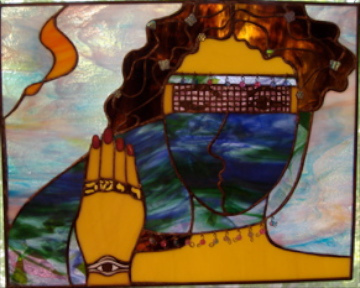
We would condemn the life of a woman like her who used clever trickery to accomplish her ends. And were it not for her prominent role in the moral stories of the Bible, we would likely pronounce judgment on Tamar herself for “playing the harlot” and thereby “playing” the self-righteous Judah for a fool. How dare she! But ask yourself what kind of outwardly misleading cost-u-me do you wear and how much does it cost-u-&-me in our relationships and dealings one with another? Who is the real harlot? Women like her get ignored because of a silent judgment against her looks. What could women possibly offer the world beyond physical beauty? It is through Tamar that the aforementioned line of Perez and Jesus Christ himself come. Jesus apparently inherited Tamar’s “disguise” since it was written of him that he came to us “with no apparent beauty that man should him desire”. If divinity disguises itself in such a manner, what might the good looking people we meet, or see celebrated on tell-lie-vision look like inwardly, underneath the physical mask? The repairing of the broken physical DNA of fallen man through Christ is symbolized by the breach of Perez. The union of Judah and Tamar symbolized the re-linking (religion) of the severed spiritual DNA of the Family of God. But the symbolism is lost on most because we refuse to see how our inner self could share any blame in our fallen state. For the vast majority of mankind throughout most of our history, we as independent spirits created by the Most High and endowed with free-will, have been unwilling to “come in unto” our physical bodies except under a strictly “payment for pleasure” basis. The attitude of Our Higher Selves towards our tabernacles of clay had been dismissive and degrading at best and despotic at worst. Only once Tamar, bearing the Son of Man, despised and scorned, finally spoke up were we redeemed. Christ, with the staff of his spine laid straight against the grain of the cruel cross, the wounds in his wrists as they were braced upon the crossbeam, he produced the sure signet bearing indisputable proof of legitimacy.
If we remain conscious of the fact that we are first spirit beings and secondly beings of flesh then we may at least acknowledge that like parents and children, neither are perfect, both the spirit and the physical body are learning, however there is a certain order which will allow both to progress and experience maximum joy. For our part as physical creatures we may be tempted to say: “Gifts of the Spirit are all very fine and well. But how is any real work of the Lord to get done without at least some attention to temporal matters?” The Lord’s answer is clear. First, the Lord has already commanded the spirit of man to care for and attend to all the needs of his physical body. Secondly, due to the psychological and physiological schisms that separate a man from his Lord’s presence, Jesus understandingly entreated us to take it day by day and not to worry so much about tomorrow. This task is easier said than done for a race that has grown so accustomed to working exclusively with action-faith as opposed to power-faith. These two modes of faith are meant to function perfectly together. You can learn more about action-faith and power-faith in this video.
We only find it so difficult to exercise power-faith because it is a function of the spirit body which typically restricts interaction with the flesh to transactions of a worldly nature to conduct business as usual in Babylon. This circumstance is partly due to the lofty-mindedness of the Spirit Self and partly due to the stubbornness of the developing physical body, which upon receiving a portion of spirit feels ready and determined to set out on its own. It is natural for us to desire independence and for the physical aspect of man to become aquatinted with grief and sorrows is good to certain extent. When we try to avoid suffering at all costs then we end up paying the utmost price at the point when all of those divinely ordained and perfectly purposed painful aspects of existence pile up and demand our attention. This is something that the philosophies of men do not take into account. Most philosophies, whether of Western or Eastern men, tend to make the physical body the “bad guy” in every instance. If anything the opposite is true when it comes to true scripture unmingled with abstinent and ascetic philosophies. The teachers of religion love to disseminate half truths that castigate one half of creation while excusing disembodied beings of light as if they could do no wrong. But God Almighty takes issue with his rebellious spirit children for not loving and lifting his material grand children, raising the sons of men in the same way that he has raised spiritual mankind. Remember that Paul told the Galatians (and the same applies to all earthlings) that when,
“….the flesh lusteth against the Spirit, and the Spirit against the flesh….ye cannot do the things that ye would.”
This accurately explains the abusive relation-chip that holds us back. This is the awful situation that we must rise above if we are ever to defeat the Secret Combinations. In this awful situation one cannot do the things that one would, or should. You can not stop thinking about all the “sufficient evil” you have on your to-do list tomorrow. You can not obey God’s word to your heart when the beggar puts his petition to you, because like him you must deal with harsh realities of a fallen world. You can not spend time with your children, let alone set a good example for them to see what powerful miracles the Lord is able to do. You can not exercise your faith right now because today is the only chance you will have to exercise your physical muscle at the gym where you paid for a year’s membership. You can not afford to take a sick-day unless you use your vacation time. You can not heal yourself when you are sick. You can not heal others. You can not free yourself from captivity to your enemies. You can not see the angels that stand ready to help you. You can not worship God according to the dictates of your own conscience. You cannot even buy, sell, or trade without taking the mark of the beast. It is illegal. But,
“If ye be led of the Spirit, ye are not under the law.”
Then you could learn another language, or several, or hundreds. You could speak with the tongue of angels. You could have the body you always wanted. You could expand your family’s horizons in countless ways. You could fly to visit Grandpa and Grandma without the use of a plane. You could see your dead loved ones again. You could know what the weather is going to be like tomorrow without having to rely on the weatherman’s best guess. You could change the world for the better. You could conquer corruption and alleviate suffering. You could proclaim and feel peace. You could praise the Lord morning, noon, and night. You could live a zen-like life where your praise and blessings flow without ceasing. You could see the face of God! You could do so many things if you were led of the Spirit.
Some people think that such stuff is nonsense and terribly impractical. I think it is terribly impractical not to be able to fly as the eagle can, or to regenerate limbs as the lizard can. If God loves and looks after small creatures like the sparrow, then why do we doubt his love and attention towards us? I think it is terribly impractical to spend the majority of your waking hours working at a job to pay the bills. It is terribly impractical for the Lord’s purposes and His grand design in giving us the golden opportunity to be a part of a golden age, contributing to something as wonderful as Zion during the millennium. But it is terribly convenient for the Devil and all the underlings who, as low as they are, still manage to rule over us. So when people try to insinuate that we Mormon mystics, or LDS anarchists “get real” just remember that to insinuate means: to suggest or hint (something bad or reprehensible) in an indirect and unpleasant way. Religionists in general and religious Statists especially have insinuation down to a science. They will intrinsically act similarly to the Gaddianton Robbers who were cowardly and had to secrete themselves in cavernous hiding places while making sneaky, indirect and unpleasant raids on others. Are you going to let them get away with it?
“The Children of God must always be mocked by the children of the world, whether in the church or out of it – children with sharp ears and eyes, but dull hearts,”
says George McDonald in Unspoken Sermons.
“Those that hold love the only good in the world understand and smile at the world’s children, and can do very well without anything they have got to tell them. In the higher state to which their love is leading them, they will speedily out-strip the men of science (state, religion), for they have that which is at the root of science (state, religion), that for the revealing of which God’s science (self-governance, religious experiences) exists.”
Insinuation also refers to a tactic that involves maneuvering oneself into (a position of favor or office) by subtle manipulation. This particular definition matches the tactics of the children of the world even more exactly in the regular activities of their Secret Combination. The reason I am reading so much into this word – insinuate – is so that I might prepare our minds to do among the haughty experts of today’s world as Jesus did among the ancient Jewish leaders. We can not feel ashamed of the testimony of Christ. We must expose the intentions in the hearts of the children of the matrix which are the inward cause of their insinuating apostasy, impropriety, or blasphemy on our part. The way I see it, to in-sinew-ate is very backwards, because it is not sinews that we are supposed to weave into a strong-arm of flesh with which to affect change. We are expected to infuse spiritual strength into the loins and sinews.
Whether you are a religionist who insinuates that non-religious people are the problem, or a non-religious Statist who insinuates that religious folks are the problem….If you are a patriot who insinuates that anarchists are not practical in our desires for liberty and justice for all….if you are an anarchist or a libertarian who insinuates that mystics are not practical in our approach….if you are a religionist who insinuates that everyone else is evil…..it says nothing of us, only of you. It says that IN-SIN-U-ATE, and in sin you continue eating, glutting yourself in your personal position secured and secreted within a Secret Combination so secret that its own members do not know of it.
To call the skeptics non-believers would be unfair, for they most certainly believe in the current system that has prevailed since the beguiling of our First Parents, spreading death, despair and decadence time and space, and it dictates the use of their action-faith. All Doubting Thomases, as they are sometimes called, are precise in the direction of their doubt. They have the utmost confidence in the rules and laws of this miserable, unjust existence, they only doubt things like miracles and freely offered forgiveness. To those who put their trust in the arm of flesh, and think the Gospel of Christ terribly impractical – to those who talk as though they are ready to take matters into their own hands – those who think in terms of food storage, guns, and ammo – I would like to say stand still and see the salvation of the Lord! But the truth is that most of you will still put your trust in these things to some extent, and what’s more dangerous, you will lean unto your own understanding. So by way of invitation I say let each man exercise his will, whether it be unto salvation or condemnation, but let him do it with more energy of soul. If you are a fund raiser then get out there and raise more funds than ever before. If you are a “prepper” make sure you horde plenty of food and plenty bullets to ward off all the starving hordes that come from neighboring areas in search of food. If you think that Zion can or will be established by means of political reform then by all means campaign and vote. If you believe the Church with which you are affiliated does valid work in saving, or even helping souls, then what are you waiting for? Shout it from the rooftops. Do what you are going to do, but make sure you give it your all!
UNTIL YOU MEET YOUR SOULMATE THE BODY CONSISTS OF CELLMATES
To my brothers and sisters who have grown weary of this world, and who through various life circumstances have arrived at a place of humility instead of hubris: let us look a little deeper into the truth of the matter, the truth of the spirit, and the truth that will be once spirit and matter are made one. There has been much speculation as to what Zion will look like, and how to approach it, achieve it, live it. I offer this study in the only way it can be offered, freely. I beseech you to not let my freedom in expression offend your sensibilities, and I hope in faith that you will not dismiss what I write because of its novelty, or its subtlety. If there is confusion at first upon consideration of the scriptures I share here, and the seemingly strange light in which I share them with you – please, reserve judgment, ponder and pray for new eyes and ears with which to understand and discern.  I do not desire to impress you with my intellect, or brag about my righteousness. I do not even see these things as “mine” but divine qualities which are available to and through all from the One True and Living God. To even speak of will as mine at this point makes little sense. I am not trying to build the blog following here or anywhere else online. I do not represent any official organization or formal movement. I am not selling any books like the old General Authorities or Denver Snuffer. Many scriptures have already been written and are available to even the poorest among us. I would like to examine some scripture which is appropriate to the majority of my audience and to which I have already referred earlier – D&C 93.
1 Verily, thus saith the Lord: It shall come to pass that every soul who forsaketh his sins and cometh unto me, and calleth on my name, and obeyeth my voice, and keepeth my commandments, shall see my face and know that I am;
Recently Denver Snuffer has received much attention, positive and negative, for making the supposedly apostate claim that anyone can see the Lord’s face. Was that the real reason, or was he excommunicated because he was selling so many books and his teachings had become quite popular with the people. Whether it was Denver’s conscious intention or not he was in competition with the Church leadership. Nephi tells us that: “priestcrafts are that men preach and set themselves up for a light unto the world, that they may get gain and praise of the world; but they seek not the welfare of Zion” (2 Nephi 26:29). Remember we discussed how it is a spiritual pitfall, not to mention a physiological impossibility for the 10 Wise Virgins in Jesus’ parable to impart of their oil to the 10 Foolish Virgins. To set one’s self up for a light unto the world is vanity and is completely unnecessary since, as we previously read in D&C 93:2, the Lord is:
“…the true light that lighteth every man that cometh into the world;”
Now I want to call attention to the Lord’s wording here. He does not say he is a light unto the world, but that he literally lights every man that comes into it. Let’s face it, Jesus was not hugely popular among the Church leadership, and neither was he readily recognized as divine by the average man on the street. He most certainly let his light shine before men, but with the intention of inspiring them to turn on their personal glory switch which would in turn glorify their Father in Heaven. This cyclical give-and-take glorification is like a divine electrical circuit. If we think that the current of the Holy Spirit is merely one-way then we fail to feel that divine electric spark and our action is similar to a kinked wire. It is up to us to affirm that divine connection. Verse 3 reminds us that in order to be like Jesus we must feel and know that:
“I am in the Father, and the Father in me, and the Father and I are one—”
What exactly are we saying here? Jesus couldn’t possibly expect others to understand him when emphatically repeating this mystifying phrase, much less to adopt it themselves as a personal mantra. That is probably the reason for his performance of miracles in the flesh, isn’t it? We think that only by actions can we prove anything or demonstrate truth. But when it comes down to it, the idea that “seeing is believing” is backwards, and comes to us from the principles introduced by Lucifer. The Light Bearer wants us to be totally reliant upon him. Light is necessary for sight in this world of his. But what truly is light? Do we cling to the burning Æther like the inflammatory personality of Lucifer as he fell through the Abyss, and by the fury of his flight kindled the air? The Æther was already there before it became visible by its burning to carnal eyes through their lenses, rods, and cones, was it not? In the fittingly titled book of Æther, in the 12th chapter, 6th verse, appears a clearly defined outline of faith and its workings. Moroni comments:
“I would show unto the world that faith is things which are hoped for and not seen; wherefore, dispute not because ye see not, for ye receive no witness until after the trial of your faith.”
Did Jesus purposefully tone it down, or dim his light before men to accommodate the world? No he was and is the Sun of God, shining in the morning, shining at noonday, at evening, and all through the night. The only differences are in our varying perceptions of his glory from distinct angles as the world turns. Jesus said: “blessed are ye if ye shall believe in me and be baptized, after that ye have seen me and know that I am” (3 Nephi 12:1). But in verse 2 he follows up with this:
“And again, more blessed are they who shall believe in your words because that ye shall testify that ye have seen me, and that ye know that I am. Yea, blessed are they who shall believe in your words, and come down into the depths of humility and be baptized, for they shall be visited with fire and with the Holy Ghost, and shall receive a remission of their sins.”
Will this fire of which Christ speaks be immediately visible to our physical eyes upon its visitation to the believing individual? Not necessarily. For Jesus tells us in 3 Nephi 9:20 that the Lamanites at the time of their conversion were baptized with fire and with the Holy Ghost, and they knew it not. If the individuals coming to the Lord with broken hearts and contrite spirits do not always see magnificent displays of heavenly light at the moment of their baptism, which is a personal witness to God and inwardly very private, then it is much less probable that onlookers to the more public performances of that ritual should see anything in the way of rays of light reaching their ocular organs. Do we expect to see plasmic discharges within the visible light spectrum of our carnal eyes before we practice feeling or otherwise sensing energetic bursts of spirit? Just because we do not perceive the angel that visits us with the sense of sight does not mean he was not sent by the Lord with an extremely important message for us? The stubborn ass of the prophet Balaam could see the Lord’s messenger and were it not for that faithful animal; the prophet’s stubborn ass would have entirely missed the angelic visitation. Sure, God could make the sign by which we gauge truth to be the sign of a dove, cloven tongues of fire, or any other visual sign, but seeing beings of light, or new stars in the heavens does not engender belief within the hard hearts of the wicked, and such light is typically only revealed to them for the purposes of protecting believers from harm, or death at the hands of those who insist on being shown signs. The Holy Spirit is not some magic wand and a True God does not use it to bedazzle mortals or to entertain non-believers.
LDSA has pointed out, and I agree with him, that the phrase “and they knew it not” (spoken to survivors of mass destruction on the American continent anciently by the voice of Christ from above a thick body of mists of darkness), can be interpreted as being specifically in reference to the group of roughly 300 composed of Lamanites and Nephite dissenters who had captured, imprisoned, and now came to kill the believing prophets, Lehi and Nephi (Helaman 5). Footnotes in the original printing of the Book of Mormon seemed to indicate this, but of course Jesus does not specify. Looking at this group of roughly 300 souls who were converted at that time, we see that the impressive pyrotechnics surrounding this event and the people involved do indeed follow the general rule of administering unto believers who have exercised faith in the crucial hour of their deliverance. Whereas LDSA thinks that Jesus is saying that these souls “knew it not” due to ignorance in theological matters, this can not be what the Savior meant because when one sees one’s self encircled in a blazing plasma pillar as each of theses individuals were able to behold, it does not take a religious expert to deduct that what is happening is a total immersion in flame without being physically burned, or consumed. Basically put, personal experiences of this nature are not something of which one is completely unaware.
But, remember that apart from the heat felt by fire, the only other key feature of fire (or plasmic discharges described in those terms), would be light. Physical sight is dependent on light, but light itself as a manifestation of the spectrum of glory is not necessarily dependent upon the short-sightedness of man’s physical eyes. It exists as it is independently from man’s ability or inability to perceive it on every level. This populous mob of prophet-killers had not merited the manifestation through scripture study, and it was not even the words of Aminidab (one of the Nephite born dissenters among them) which “illuminated” their darkened minds. It was their faith in the unseen which granted a lifting of the thick cloud of darkness that hung over all of them. They found themselves in the same benighted condition that the mix of Nephite and Lamanite survivors at the time of Christ’s visitation found themselves years later. The reason that those 300 saw pillars of flame around Nephi and Lehi, was because they were taken by surprise, ambushed as it were by the flash of extreme belief generated by those two men in the Lord their God. Their own soul’s immediate reaction was to shake violently from the sudden and unexpected penetration of their collective perspective. Never having known the Lord as a personal God was what automatically thrust them all into a sudden state of shock brought on by such an abrupt awareness of something beyond the black veil which they were accustomed to believing was an impenetrable border marking the edge of all there was to see. Confronted with the light of truth, their souls immediately retreated, but the veil of darkness was now all they could see, since their awareness had been pulled to that edge. Lost in that thick curtain, the crowd panicked, stumbled, and faltered till a still small voice spoke to them from above the darkness. (This voice sounded from above somewhere overhead and could possibly be related with the Dreaming Emissary as described by Carlos Castaneda and other lucid dreamers. The voice above their heads tells them things that they should have already known as evidenced by Aminidab’s later reference to the prior instruction of Alma, Amulek, and Zeezrom. This is of particular note because Castaneda was told by his spiritual teacher, Don Juan, that the voice of the Dreaming Emissary can only remind one of what they ought to already know.) The voice pierced their souls and caused their frames to continue gyrating violently while the walls of the prison remained firm and unaffected. At this point though, they were already encompassed by pillars of fire. The darkness in which they were collectively enveloped was the real, and plain reason that they “knew it not”.
As soon as they exercised faith in Christ, who had been taught unto them by Alma, and Amulek, and Zeezrom, the darkness dispersed. (obviously this refers to Nephite dissenters specifically unless there is a missing record of Alma, Amulek, and Zeezrom preaching to the natural-born Lamanites) The darkness had not so much seized them, but they were simply passing through it, similar to Joseph Smith immediately following his glorious First Vision. The darkness dispersed because of their faith in what they had seen flashed before their eyes and the voice they now heard. They, like the Brother of Jared, could no longer be kept without the veil (Ether 12:21). When the darkness dispersed, that is when they knew that they were each surrounded by a personal plasma pillar, baptizing them in fire. The phenomena evolved to an inner baptism of the Holy Ghost which filled them as with fire. Now in that state they were able to view ministering angels descending out of a heavenly opening. After this miraculous event they were commanded to go forth and share what they had seen and heard, and to not marvel or doubt. This commandment to marvel not, nor doubt was important because it was not likely that their walk of faith would be graced with many more experiences of the same magnitude of that day in the same prison where Ammon and his brethren were cast by the servants of Limhi.
But just as the baptism(s) of fire had been for those 300 a simultaneously individual and collective phenomenon, and just as it had begun regardless of their collective or individual level of awareness (triggered by the faith of those two prisoners), so the truthfulness of the wonders they all encountered were to remain bright in their memory and held sacred in their hearts, even through times of darkness ahead, and in spite of the lack of visual confirmation as they progressed in faith. The resulting spiritual conversion was not limited to these 300 souls, but swept across the land, where it took great hold at least among the Lamanites who were so purified by their respective baptisms of fire that they conceded the lands of the Nephites which they had formerly taken by force. They made and kept a promise to the Lord to “seek no more to destroy [his] servants whom [he] sent….to declare good tidings.” These things happened around the time of Jesus’ birth on the other side of the world in Jerusalem. Then around the time of Jesus’ crucifixion, another throng of Nephites and Lamanites once again were enveloped in a cloud of darkness, and told by a voice on high to offer up no more the shedding of blood, but instead to offer up the sacrifice of a broken heart and a contrite spirit. They were told that if they would do this, they would be baptized with fire and the Holy Ghost like the Lamanites were at the time of their conversion while they were in the dark and, “knew it not.” (3 Nephi 9:19-20)
The element of fire is used by God as a purifying flame which is always accompanied by a certain heat that can be felt to warm and comfort the bosoms of men in a sensation that is instantly spiritual and physical. The wild-fire patterns of popularity and success for Denver Snuffer’s timely book series are very different from the spreading fires of conversion among the Lamanites. This fire is not taking as strong a hold and is spread mostly due to wild-winds which are stirring up the hearts of many these days. Unfortunately the majority of the hard-hearted LDS are not stirred up unto repentance by these winds. The Brethren and a host of bloggers in the LDS community blow hard. But this only produces light breezes that softly caress the many souls who were growing restless in their hearts, and whispers a lonely lullaby that lulls them back to sleep. Reverend Snuffer was very careful not to step on the feet of those who belong to the leadership half of our cabal, but it is impossible to toe that line between leaders and the led without disturbing the precarious imbalance of a Secret Combination like ours. The Holy Ghost is a Comforter, not an appeaser. Sooner or later we all have to wake up.
And, upon awakening, what shall we see? I am reminded of the Christmas carol – Do You See What I See? Is it necessary that everyone see what I see in the same way I see it? Does everyone have to “see things” the way Smith, Packer, or Snuffer does? Perhaps what makes Joseph’s First Vision so special is the fact that, much to the satisfaction of his critics, Joseph did not go around sharing this deeply intimate experience with anyone and everyone right away. And they find fault with the fact that years later when he actually recorded it, he was still trying to grasp the magnitude of meaning conveyed in it. If it is not God’s formula to reveal himself to everyone then is the Church leadership right to defend their God’s privacy by means of shunning Snuffer? If they are mistaken, and it is God’s formula is to reveal himself to everyone in precisely the same manner, which manner is that exactly? If there are indeed similarities in the divine encounters experienced by various people ranging from Adam to Mohonri Moriancumer, from Moses, to Mohammed, and from John the Revelator to Joseph Smith, then what necessitates the publishing of Reverend Snuffer’s works, or the circulation of Packer’s inferences – especially when they provide less details than most scriptural accounts of direct dealings between man and his maker? What is so special about these “special witnesses” and why should Reverend Snuffer be so reluctant and vague about his encounters with the divine, yet so profuse in detailing procedures for the saints to know the Lord?
Another author who is immensely popular among the LDS people is C.S. Lewis. In a book which bears a title reminiscent of D&C 132’s reference to a “far more, and an exceeding, and an eternal weight of glory” C.S. Lewis spoke of our innate homesickness for Heaven and the longing we feel for the portion of spirit which inhabits these temporal bodies to finally see our long lost friends again. Nothing is real till Israel reunites her scattered and lost tribes. Our physical beings must meet their spiritual counterparts and return to live in love supreme. It is the Secret Combination of the two which keeps us shut out from the presence of the Lord and unable to move from being inmates to being intimate in our connection to each other and to God. Lewis described it this way:
“In speaking of this desire for our own faroff country, which we find in ourselves even now, I feel a certain shyness. I am almost committing an indecency. I am trying to rip open the inconsolable secret in each one of you—the secret which hurts so much that you take your revenge on it by calling it names like Nostalgia and Romanticism and Adolescence; the secret also which pierces with such sweetness that when, in very intimate conversation, the mention of it becomes imminent, we grow awkward and affect to laugh at ourselves; the secret we cannot hide and cannot tell, though we desire to do both. We cannot tell it because it is a desire for something that has never actually appeared in our experience. We cannot hide it because our experience is constantly suggesting it, and we betray ourselves like lovers at the mention of a name.
Our commonest expedient is to call it beauty and behave as if that had settled the matter. Wordsworth’s expedient was to identify it with certain moments in his own past. But all this is a cheat. If Wordsworth had gone back to those moments in the past, he would not have found the thing itself, but only the reminder of it; what he remembered would turn out to be itself a remembering. The books or the music in which we thought the beauty was located will betray us if we trust to them; it was not in them, it only came through them, and what came through them was longing. These things—the beauty, the memory of our own past—are good images of what we really desire; but if they are mistaken for the thing itself they turn into dumb idols, breaking the hearts of their worshippers. For they are not the thing itself; they are only the scent of a flower we have not found, the echo of a tune we have not heard, news from a country we have never yet visited.”
― C.S. Lewis, The Weight of Glory
Speaking on the popularity of such books that promise success in this life, books like the best-seller The Secret, and the follow-up to it called The Power, a virtuous young woman I met in the Caribbean once told me:
“The Secret is that we have Holy Spirits. Those spirits need to be nourished and they can only be nurtured by one thing. That’s why after all the music, all the drugs, all the food, all the money, life seems to fall short. And when everything falls short and we sit there hopeless, broken, or even just bored…we turn to the most powerful force on the face of this planet in an attempt to fix ourselves.”
I asked her what she felt was the only thing that could nourish our spirits, and she said:
“Love…true love ignites our souls and awakens the dead parts inside of all of us. Almost like magic. The Most High IS Divine Love. LOVE IS The Most High.”
There are also self-help books that claim to be food for our spirit. The bright minds that write them and market them focus us on a promise of not only success in this life, but also in the next. How intriguing! How exciting! How enlightening! How much does this book cost? LDSA candidly and realistically depicts these book vendors in a satirical interview with an imaginary character named Harold P. Kraft, who just so happens to perfectly fit the bill of many popular LDS authors.
Interviewer: Now, the second book, and for our listeners, that book was called, The Secret Knowledge that No One Knows Except Me and Jesus, But I’ll Tell You Anyway!, that book I couldn’t put it down.
Kraft: No one could. I had people jokingly tell me I ought to run for prophet. They kept saying to me, “It’s like the Savior is back! You’ve brought the Savior back!” Of course, that’s just silly. I am just a lowly mortal. I did nothing. The Lord did everything through me and my nothingness.
Interviewer: What’s amazing is that the second book cost more than the first, yet sold better. How do you explain that?
Kraft: I realized that the people hungered for more than what they were getting at church and I realized that they wanted what I could offer them. So I offered them more, more pages, more words. The book was almost twice the size of the first one, at 789 pages, so I had to make the price commensurate. I think it sold for $39.97 or something like that, so although the book was double in size, its price was not. I was giving them a better deal, something really for nothing.
As LDSA’s satire highlights the fact that there are many among us who succumb to the natural man’s tendency to be prideful. We sometimes say that such a person is “full of his/herself” but in reality that person is very empty and seeks to fill the void with things which it sees outside his/herself. Jesus broke it down very succinctly. Confused Rabbis were once again attempting to ensnare Jesus in his words and trip him up by asking about the many laws of man. As they did centuries later with Bob Marley, they hoped Jesus would single out one of their many laws as higher and thereby set aside other laws which they could accuse him of disregarding. He answered them that there was no great commandment in the law, but rather a Great Law of Love which flows through all situational regulation, and it was that Law only with which the Master Teacher concerns himself.
“Jesus said unto him, Thou shalt love the Lord thy God with all thy heart, and with all thy soul, and with all thy mind.
This is the first and great commandment.
And the second is like unto it, Thou shalt love thy neighbour as thyself.
On these two commandments hang all the law and the prophets.”
– Matt. 22:37-40
Jesus says to love the Lord thy God with all your being. He then says to love your neighbor as your own being. If there are three distinct beings mentioned here, namely:
1. Your God
2. Your Neighbor
3. Yourself
…and if it is implied that we love all three with all energy of soul then why does Jesus say there are only 2 commandments upon which all the laws and the prophets rest? The First and Great commandment to love the Lord your God with all your being is straightforward. And the second like unto it. So, Jesus did not miscount. He did not make a distinction between loving yourself and loving your God. This is one action done with all the heart, all the soul, and with the entire mind. Anyone who differentiates between God and Self is demarcating a boundary that makes enemies of the two, and though he feign devotion to a higher power, he is not wholly devoted to holiness, only dead-I-cated to the devilish doctrine of division which will make it impossible to refrain from discrimination among his neighbors. Remember I said that the scriptures establish a specification with the usage of two terms – “the Lord YOUR God” and “your God AND my God”. To clarify for those parts of our minds that need to see some sort of delineation, the scriptures are extremely precise. It is our minds that are dull with corrosion and unready to receive, or fully acknowledge truth. In the following verses of Matt. 22 we see that Jesus puts an end to all the Pharisees questions with a question of his own for them.
Jesus asked them, “What think ye of Christ? Whose son is he?” They say unto him, “The Son of David.”
Jesus responded, “How is it then that David, speaking under the inspiration of the Spirit, calls the Messiah ‘my Lord’? For David said:
The LORD said unto my Lord, Sit thou on my right hand, till I make thine enemies thy footstool.
If David then call him Lord, how is he his son?”
And no man was able to answer him a word, neither durst any man from that day forth ask him any more questions.
Even though Jesus simply points out David’s deferral of ‘my Lord’ to ‘The Lord’ a Pharisee can only see heresy. A Pharisee clings tooth and nail to hearsay and labels as heresy anything within the realm of intimate, first-hand knowledge. But the Bible makes it “Christ-All Clear” that real knowledge is always an intimate affair. Anything or anyone worth knowing is worthy of an intimate encounter, and to establish a “hitherto shalt thou come, but no further” relationship between man and his maker is to promote ignorance and set up Satan’s Secret Combination. We say that Cain was the founder of the original Secret Combination, and this rejection of intimacy was exactly Cain’s response when he said: “Who is the Lord that I should know him?” With that attitude setting the tone, is it at all surprising to later hear Cain deny knowing of Abel’s whereabouts, asking the callous and infamous question: “Am I my brother’s keeper?” The word “know” is consistent in Moses 5 as it is throughout the rest of scripture with its meaning connoting an intimate act, not necessarily sexual in a carnal sense, but nonetheless intimate. We have all heard it said that sharing is caring, but we often fail to realize that sharing is knowing. Jesus shared the parable of the Good Samaritan showing that he recognized the seamless link between Love of God and love for one’s fellow man. His shameless sharing left the confused Rabbis even more confounded. He exposed religion as a sham and shamed those religious teachers and leaders in their conniving. The things Jesus shared showed that Jesus knew and understood the subtle yet eternally vast difference between the Secret Combinations of the Devil and the Open Combination of God in all things. At that point in his mortal ministry when Jesus plainly exposed the truth and shocked and silenced all the Pharisees for the last time in terms of trying to pick doctrinal debates, we see Jesus share a paradoxically private, inside moment of triumph with a brother who spots the subtlety in Jesus’ out-in-the-open yet multi-layered truth sharing style. The man exclaims:
“thou hast said the truth: for there is One God; and there is none other but he,”
to which he adds:
“And to love him with all the heart, and with all the understanding, and with all the soul, and with all the strength, and to love his neighbour as himself, is more than all whole burnt offerings and sacrifices.” (Mark 12:32,33)
When the man says, “to love his neighbor as himself” the word ‘his’ can only be referencing one person since his previous statement declares that there is no one else other than God. Self-ignorant scribes would later translate the text without a capital ‘H’. But there is a reason why the Scribe addressing Jesus used the word ‘his’ and not ‘thy’ or ‘one’s’. This reveals the true nature of possession and reveals as hypocrites and liars those who claim to serve a God who is sovereign above all, yet divide loyalties among other things hither and thither into categorical hierarchies. Was this man mistaken in his reasoning? Did he mistake Jesus’ sayings, or do we? Well, the scripture says that Jesus answered him discretely and told the scribe:
“Thou art not far from the kingdom of God.” (Mark 12:34)
The individual is the connection between God and neighbor. Now we should be able to make more sense of Christ’s explanation of the two-in-one concept of “I-in-Father-Father-in-Me” which continues the study in D&C 93 verse 4.
The Father because he gave me of his fulness, and the Son because I was in the world and made flesh my tabernacle, and dwelt among the sons of men.
The everlasting Open Combination which is most desirable between God and mortals is often referred to with the title of the Holy Priesthood after the Order of the Son of God. In all ancient languages and many still in use today, the words ‘son’ or ‘sons’ carry the meaning of ‘child’ or ‘children’ – sons and daughters. This is why there is a distinction between the “sons of men” and the “Son of Man”. For a people such as the LDS who appear to be the most family focused group on the face of things, if not the face of the earth, in these latter days, we should not find it difficult to conceptualize of our mortal cellves as God’s Grandchildren. If God is Mormon, certainly he would have numerous concourses of grandkids. What we really need to understand is how to “grow up unto the Lord” by recognizing our true selves as God’s immortal children who have received such a glorious inheritance only to squander it instead of caring for our own flesh and blood. We have not done right by our own flesh and blood. We have not been “raising” our “children” in “incorruption.” Our neighbors who we are commanded to love as ourselves are sometimes viewed with pity, or even disdain on our parts, if those neighbors come from “broken families” where the “good old fashioned” grandparents are forced to shoulder the burden of raising babies because the parents neglect or reject their divine calling. But we are vain and ignorant. The neighbors down the block may be poor underachieving druggies and deadbeats, but our white picket fences encase white sepulchers full of dead men’s bones. Our worldly achievements are our addictions, and our vanity is our poverty of soul.
It is key to note that acceptance of the Fullness of the Father is what made Jesus into the Father, and that taking that fullness into the world via the vehicle of a temporal tabernacle is what made him the Son. I say “made” because, though not in the way of the world, in accordance with the conditions instituted from before the foundation of the world, Jesus was a “made man”. We might even say he was “the” made man or the first man to complete the process of being made perfect in spirit and flesh. He showed us how it is done. Now it is our turn. But how can we possibly hope to receive the Fullness of the Father? The answer is painfully obvious – through faith in the Lord Jesus Christ. The question we ought to put to ourselves is what has kept us from even thinking of asking and accepting that fullness in the first place? It may seem obvious, however it is worth pointing out that a spirit that not only bears the title but truly is a father in that he has spiritually begotten at least one spirit child does not cease to exist by passing on his fullness. Rather, a spiritual father emits energy and perfectly duplicates himself. Now here is the trick, in order to be truly perfect the duplicate must also have free-will to execute work independently. Worldly fathers often try to live vicariously through their sons. But such attempts are never successful. In fact they are always disastrous in one sense or another, because they begin with the bypassing of that intensely spiritual process of depositing one’s self fully, passing one’s fullness into another.
“We must be willing and able to go beyond ego to reach out to something more, to experience the parts of ourselves that have nothing to do with the agendas of our personalities. At the same time, we must also be willing to experience the limitation and pain that our ego’s habits are causing us.
In the last analysis, learning how to transcend the ego involves nothing less than learning how to be open to love. Only love has the power to save us from ourselves. Until we learn to truly love ourselves and others—and to accept the love of others—there can be no hope of lasting happiness or peace or redemption.” (Don Richard Riso and Russ Hudson – Personality Types, 460-61)
GOING FROM BEING INMATES TO BEING INTIMATE
To be a servant in our Father’s house is not necessarily synonymous with being a Son of the Father. For a real father & son relationship to occur there needs to be a going out, and a coming in of pure spirit. Most of us have done the first part. Like the prodigal son we have opted to take our inheritance and go out into the world. But now that we are here we have made the mistake of squandering that portion of spirit that the Father gave us when we left his presence. What is worse, we commit the sin of pride and we do not call home to ask for more. Thinking that we can do it on our own, leads to thinking we must do it on our own. Our own stubbornness and selfishness turn to forgetfulness and get falsely attributed to God. And how would we know any different so long as we refuse to accept God’s attributes for incorporation into our bodies? Fariduddin ‘Attar, the mystic Sufi saint of Iran wrote:
It is those who cannot see straight who fall into error: This is the sightedness of the man who denies God attributes. Ah, the pity! Nobody possesses the power: Eyes blind and the world filled with sunlight!
Walking in darkness at noonday as the scripture says (D&C 95:6) we stumble around as self-made victims when we could be enjoying a continuous flow of power from on high. A little work is required, but it is not the same strenuous, frivolous and futile labor of the flesh. Jesus told us that his yoke was easy and his burden light. To receive the Fullness of the Father means essentially to yoke, or sync up the Power Faith by which our immortal spirit body operates with the Action Faith which our mortal body uses to assert its self in this existence. An infusion of spirit and flesh is necessary in order for Power Faith from on high to bleed effortlessly into Action Faith as exhibited here below. Jesus expounds upon this process in verse 5 of D&C section 93.
I was in the world and received of my Father, and the works of him were plainly manifest.
So first we have to be in the world. Great! Here we are! Then we have to receive of our Father. Great! We have already done that, and we dip into that supply everyday! All that we lack is to keep doing this and perfect the process. Not even Jesus received the fullness at first. Verse 12 says that he received “grace for grace” and continued from “grace to grace” until he received the fullness. The moment when Jesus received the fullness appears to have taken place at his baptism. Section 93 now quotes from John and tells us:
14 And thus he was called the Son of God, because he received not of the fulness at the first.
15 And I, John, bear record, and lo, the heavens were opened, and the Holy Ghost descended upon him in the form of a dove, and sat upon him, and there came a voice out of heaven saying: This is my beloved Son.
The confused masses of Christ-Shuns go to the doctors of the Church for prescriptions (doctrines). Some of these doctrines are of men and others are of devils. None of them can cure us. One of the most popular drugs on the market today is a sin-thetic perversion of the doctrine of divine sonship. It is advertised as something that was instantaneously inherited by Jesus at his birth and something to be kept out of the reach of the children. But such poison pills are not of God. If you will read the ingredients listed in the per-scriptures you will see that Jesus (the physical man) did not become a Son of God until he accepted Christ into himself. He was born Jesus and reborn as Jesus Christ – Son of God.
Jackson Browne – Doctor My Eyes
Doctor, my eyes have seen the years
And the slow parade of fears without crying
Now I want to understand
I have done all that I could
To see the evil and the good without hiding
You must help me if you can
Doctor, my eyes
Tell me what is wrong
Was I unwise to leave them open for so long
‘Cause I have wandered through this world
And as each moment has unfurled
I’ve been waiting to awaken from these dreams
People go just where they will
I never noticed them until I got this feeling
That it’s later than it seems
Doctor, my eyes
Tell me what you see
I hear their cries
Just say if it’s too late for me
Doctor, my eyes
Cannot see the sky
Is this the PRICE for having learned how not to cry
.
Divine Lawgic – The Cycle
Jesus suffered the children
He knew the way they felt
Children suffer like Jesus
’Cause every day they’re dealt
Punishments that they didn’t deserve
Feel the centripetal force as we swerve
Through the curve
Of The Cycle
If we are to become again like little children then we most certainly need to relearn how to cry. To more fully receive of the fullness when undergoing a baptism of water we need to be WILLING TO GET WET, not just physically but emotionally. In John 11: 35 it tells us that “Jesus wept.” Although this is the shortest verses in all scripture, and seemingly very non-descript, I believe that this time in Jesus life was another baptism of water or at least another level of it for him. A wave of emotion starts to come over Jesus at this point. He weeps, he groans in the spirit and in himself (John 11:33,38), Jesus even vacillates and shows signs of nervousness. He says in John 12:27….
“Now is my soul troubled; and what shall I say? Father, save me from this hour: but for this cause came I unto this hour.”
Nephi pointed out that the Lamb of God was baptized in water to fulfill all righteousness. But then Nephi asks us a question: In what way did the Lamb of God fulfill all righteousness by being baptized in water? Nephi asks us this question because he does not want us committing the common error of supposing that the answer is in the physical ritual alone. We can talk all we want about the importance of gospel ordinances but without recognizing the pre-ordination to which the actions are meant to link, we are talking about a gospel gadget which is of no good with no power source. Alternately if we address the issue of the Pre-Stood Power as if it were the socket into which we must plug, then we have missed the point again – mistaking the outlet for the energy itself or accepting it as the ultimate source. And just as Nephi, my heart too delights in plainness. So, just in case we are tempted to take the analogy of electrical current as used by modern man, and apply it directly to the availability of the Pre-Stood Power of GOD, let us be perfectly clear:
TITHING FUNDS PAY THE BILL FOR LIGHTS & ELECTRICITY IN THE CHURCH OF JESUS CHRIST OF LATTER-DAY SAINTS.
THE PRE-STOOD POWER OF GOD IS AVAILABLE AND GIVEN TO ALL MEN LIBERALLY AS IT IS ACCEPTED LIBERALLY BY THEM IN THE BODY OF CHRIST – FREE OF CHARGE (MONETARILY SPEAKING) FULL OF CHARGE, AND FULL OF LIGHT (SPIRITUALLY SPEAKING).
Nephi says that through the baptism of water Jesus received light, glory, and power accorded to his flesh. In order for this to happen his body of flesh had to humbly accept the role of Holy Lamb of God.
For what doth it profit a man if a gift is bestowed upon him, and he receive not the gift? Behold, he rejoices not in that which is given unto him, neither rejoices in him who is the giver of the gift. (D&C 88:33)
Nephi also asks us rhetorically whether or not we know that the Lamb of God was Holy. He asks us this so that we might make the mental connection between a baptism of water later in life and one’s own birth coming straightway out of the waters of the womb. He wants us to understand the plan of redemption and recognize innocence when we see it. Little children are every bit as holy as was Jesus. In fact Moroni states that they are “alive in Christ, even from the foundation of the world” (Moroni 8:12). If we will skip ahead in our reading of D&C section 93 we find that:
38 Every spirit of man was innocent in the beginning; and God having redeemed man from the fall, men became again, in their infant state, innocent before God.
We will return to this scriptural elucidation of our innocence before God later. But for now let us resume our investigation of baptisms of water and fire, and how exactly it is that they can bring about the fulfillment of all righteousness. Fulfillment of all righteousness is a quality of eternity. As seen filtered through the lens of time it is an ongoing or cyclical process. As Nephi points out, simply because one enters into time through the strait and narrow gate of the birth canal, does not mean he has completed all the works that the Father would have him do. This is where Action Faith comes into play and fulfills its crucial part in the divine plan. Re-baptism, or re-birth, resets us in that course we found ourselves in as infants, but it does not negate the need to keep moving either. Jesus, for example had only just begun his 3 year ministry when he was baptized by his cousin John. We can not say that the baptism of fire wherein the Holy Ghost descended upon him in the form of a dove was the completion of his works. Only a fulfilling of all righteousness, or a filling up of all three levels of God’s righteous creation – Intelligence, Spirit, and finally Flesh. This was like a stop at a spiritual filling station before Jesus set out through the gate and on the path to another baptism of fire. He brings up this next baptism of fire and the burning desire he had to accomplish it in Luke 12.
49 I am come to set fire to the earth, and I only wish it were already ablaze!
50 But I have a baptism to be baptized with; and how am I straitened till it be accomplished!
You will recall that Nephi also uses the word strait to depict the path one enters after the baptism of water. When Jesus says he is “straitened,” this can also be translated as being “pressed” or “pent up” until the baptism has reached its completion. Jesus had grown in wisdom and stature as a young man and now, since receiving the Fullness of the Father, he was literally outgrowing this level of reality known as the 3rd dimension. It’s been theorized that the whole realm of human experience which we inhabit can be closely calculated to exist within a base rate wavelength of 7.23 cm. This measurement corresponds to the average length of space between a human being’s eyes from the center of one pupil to the other. It is the average distance from the tip of the chin to the tip of the nose. It also matches the span of the palms of many humans’ hands. And it is the approximate distance between the chakras in our spirit bodies. This 7.23 cm motif can be found repeated in various ways throughout our bodies because we are submerged within this particular universe and it is embedded within us. But if you think 7.23 cm is narrow, try to imagine the 4th and subsequently higher dimensions. As you go up the wavelength gets shorter and shorter, with higher and higher energy. As you go down in dimensional levels, the wavelength gets longer and longer, with lower and lower energy. This is why Jesus told us:
“Enter ye in at the strait gate: for wide is the gate, and broad is the way, that leadeth to destruction, and many there be which go in thereat:
Because strait is the gate, and narrow is the way, which leadeth unto life, and few there be that find it.” (Matt. 7:13-14)
LDSA has stated these truths as plainly as he can in the following statement:
“You are either immersed in plasma or you are not. You are either in an intensity phase or in a rest phase of the cycle. There is no such thing as non-cyclic gradualness. If you think you are growing spiritually for the past ten years without any intense spiritual experiences, you are kidding yourself. It means that you have been in a spiritual rest phase of the cycle during this time. No one can remain at spiritual rest for any extended period of time before spirituality begins to decay. It is an impossibility. So, the LDS concept of a gradual, life-long, imperceptible baptism of fire is patently false and leads to spiritual death.”
From heights which afford a god-eye or more eternal vantage point there is of course a perceivable gradual build in the process of perfection. God rested on the 7th day. But remember that the Father is not alone in this work. When he rests from his labors then the Mother’s labor has only just begun. LDSA is right. There is no such thing as non-cyclic gradualness. But he does not say there is no such thing as gradualness. What can be called a rest phase of the cycle on one end is on the other side of the cycle moving into intensity phase. This is the meaning behind the Yin-Yang symbol, and constitutes the basic tenet of Feng Shui as it follows the cyclical flow of Ch’i energies – that as the nature of anything moves toward the extreme, so it gives birth to its opposite. Continuing from “grace to grace” as Christ did certainly describes some sort of graduation. But then, as I mentioned earlier, there come periods of transition and completion that are intense and experienced in time as moments when we feel a burst of eternity. From this side it may seem as if nothing is happening but if we are receptive then we will know that the Father is doing his work, and will be ready to meet the movement as it cycles around to us. He does his work for all of us. It will always come to each of us. But it will not flow through those who resist it. How can one resist something so powerful as the work of the Holy Father? They who resist never survive unharmed, simply because positive effects can never be forced upon anyone. If we would receive grace upon grace, then it is essential for us to understand what is happening during our rest cycles.

You will notice that the above conceptual mapping of the flow of eternity matches the patterns formed by the spiraling of our DNA. We are to be still and submit, letting the active energies flow into and through our bodies. These cycles will most definitely be felt as intense moments, and LDSA is right to offer us the wisdom of a ten year gauge. If you have not felt any such intense movement of the spirit within a ten year span then you are definitely dying. You will want to do something immediately to remedy that situation. Or rather, you must stop doing whatever you have been doing which you erroneously considered so important to your spiritual progression. Stop it now, and hold off from doing those things for as long as you can, for as long as it takes, till you feel the burn in the faith muscles of your sorely under-worked spirit body. The burn is literal, not the same burning of physically pumped muscle, but similar. Though not in the manner or role typically accepted and taught at Church, the physical body does play a vital role in our spiritual progression. It is challenging for most Church-goers to understand because that role is passive. In Feng Shui, Ti Ch’i (not to be confused with Ta’i Chi which we will discuss later) means Earth Spirit, and is sometimes called “host ch’i” because earth elements, like those which constitute our physical bodies, are made to host the heavenly elements. Or, as it is stated in the D&C – Truth hosts Light. Ti Ch’i – the Spirit of Truth bears witness of the Father & the Son.
Your physical body, composed of earth elements, was made to bear witness to the Father & the Son. Dr. Bradley Nelson, author of The Emotion Code and a member of the LDS Church demonstrates how the body can communicate answers from God with subtle sensations that may be used to engage in clear conversation and direct dialogue with spirit. Most have not or will not consider what Justin and others on this blog have discussed since the posting of an excerpt from NCCG.ORG by LDSA. The average Mormon or Christian will say that the Holy Ghost can not be feminine in any other sense than the linguistically generative sense of the Hebrew words for Spirit and Holy Spirit. Christians will hold doggedly to their Homoerotic Model of the Holy Trinity and will say that the mere idea of a Holy Mother beyond Catholic Virgin Worship is utterly pagan and therefore of the devil. Many protestant groups will even vilify the Catholic view of a Holy Mother. And The LDS will forever play the fence, condemning Catholic practice as a distraction while reveling in rumors of a Heavenly Mother who, in keeping with her Puritan, Victorian, and LDS ways, never will reveal too much about herself. Even fewer people will allow themselves to come to a comprehension of Her as physical earth element. Earth elements to them are dirty, and the Heavenly Mother in their minds must be after their vain narcissistic reflection – pristine and prissy – an evil snow queen who thinks she knows what she is doing.
Even those who are not as prideful in their thinking, but more genuine in their curiosity, will be confused because of the doctrinal idea that the Holy Ghost does not have a body. They will not allow themselves to see that the third member of the Godhead has no individual body of flesh and blood because She is the Mother of All Living, out of whom are composed endless individual life-forms. She spreads Herself far and wide and forgoes a form unique to herself so that She can, through physical creation, witness that there is a God. Nowhere does She express Herself and Her mission as fully as in Womb-man. So I tend to agree with LDSA and Justin – The Holy Ghost is a Woman. Dallon J. recently made a comment that brought up the idea that the Father will forgive anything except the reviling against and flat-out denial of the Holy Ghost. Does that include denying women the priesthood? Remember that one of the key features of the Secret Combinations since their early establishment in the history of this planet is that “It was among the sons of men. And among the daughters of men these things were not spoken” (Moses 5:52-53) Many Mormons in Utah and other parts recently peacefully demonstrated their disapproval of Church policy at the Priesthood Session of General Conference. In the end, being granted permission to enter closed meetings, or entrance into a leadership group traditionally limited to a “boys only” club will do nothing. But on the other hand priesthoodlums with all their pretending can do nothing to stop a woman from receiving the Father, witnessing to the Truth, and wielding the real priesthood in great power. There are opportunities for the restoration to move forward, and for real power to pour into our bodies at regular intervals. If the beneficial blessings of God come into our lives but are not let into our bodies then we are taking unrighteous advantage and we have yet to actually know God.
These cycles of spiritual activity come around regularly, but can only be detected and properly, more fully processed when the physical body is at rest, or ease. No amount of activity in the Church can compensate for activity in the Spirit, and in fact our over-doing it will hinder us because it inevitably leads to over-looking the spirit. This is The Damnation of Inactivity that I addressed in one of my earliest posts. The intense cycles of Yang energy from the Father which come to us when we are in a rest phase are called “quickenings” for the flesh. To quicken means to come to life, to give life to. It also connotes of course that something is made faster. They are called quickenings because of how, through time, they are perceived to be much more abrupt and quick than the normal everyday flow. Really they are only landmark points of unity gained as spirit and flesh tie in together to become one. (See the graphic above which illustrates the DNA-like progression of eternity) In D&C 88 we read:
29 Ye who are quickened by a portion of the celestial glory shall then receive of the same, even a fulness.
30 And they who are quickened by a portion of the terrestrial glory shall then receive of the same, even a fulness.
31 And also they who are quickened by a portion of the telestial glory shall then receive of the same, even a fulness.
32 And they who remain shall also be quickened; nevertheless, they shall return again to their own place, to enjoy that which they are willing to receive, because they were not willing to enjoy that which they might have received.
These quickenings are of extreme importance, however, they do not represent any one individual’s strength to create change of or by his self. Creation did not start with the Big Bang. There was a slow and steady movement which from this side of things was completely imperceptible, but which nevertheless built up to that explosive moment where time began. In the mid 60s to the late 70s, Arno A. Penzias and Robert W. Wilson, while working for Bell Labs, discovered what they called cosmic microwave background radiation, a nearly uniform glow that fills the Universe in the microwave band of the radio spectrum. They were experimenting with a supersensitive, 6 meter (20 ft) horn antenna. Upon reduction of their data they found a low, steady, mysterious noise that persisted in their receiver. This residual noise was 100 times more intense than they had expected, was evenly spread over the sky, and was present day and night. They were certain that the radiation they detected on a wavelength of 7.35 cm did not come from the Earth, the Sun, or even our galaxy.
Notice how remarkably close they were to that base rate wavelength of 7.23 cm which is the basic band for the 3 dimensional reality which we inhabit. After thoroughly checking their equipment, removing some pigeons nesting in the antenna and cleaning out the accumulated droppings, the noise remained. Both concluded that this noise was coming from outside our own galaxy—although they were not aware of any radio source that would account for it. Penzias and Wilson were awarded a Nobel Prize in 1978 because their discovery bolstered the assertion that the Universe had its beginning with a Big Bang. Big Bang theory gained prevalence in the scientific and academic community from then on. It was to the secularists a huge victory. The Big Bang came to be heralded as a blinding Bearer of Light who blocked or barred any further investigation into the mysteries of God. Lucifer had people convinced that it all started with him – that he in fact had triggered the creation and put the plan into motion. Since the days discussed in Moses 5 till now, the sons of men have become increasingly more convinced that things are done through demon-strations of sheer masculine energy. Nothing could be further from the truth, but no one is willing to give up the spot light and admit they are all riding on a dark wave of feminine energy with the force of trillions of megatons behind them.
Just as the Big bang seems so important to the scientific community, the At-One-ment is said to be the pivotal moment for the plan from a Christian outlook. I wonder if many of us pause to realize the Crux of Creation continued before us on the Cross of Calvary. Many eyes are being opened these days to the prison planet that this world has become. Jesus made a prison break from this prison planet. He did not only sneak off leaving us with high hopes but low chances of escaping ourselves, but he actually cast out the warden. If we will stop being our own prison guard, torturer, and warden, then we will realize what a great thing Jesus has done for us. But simply praising him in name only, while continuing to kowtow to systems of control, is hypocritical and pathetic. Jesus’ sure hope was in expressed in John 12:31-32 when he said:
“Now is the judgment of this world: now shall the prince of this world be cast out.
And I, if I be lifted up from the earth, will draw all men unto me.”
The Jesus-led prison break is completely comparable with the Fall of Adam (Father let this cup pass from me. Nevertheless thy will be done”/“I see that this must be. I will partake that man may be.”). The At-One-ment is also congruent and synonymous with Michael’s victory over the Dragon in the pre-mortal realm. And like the Big Bang, Christ’s atonement actually resulted in the furtherance of the creation of the Kingdom. Remember he also said: “I go to prepare a place for you.” (“It is good.”/“It is finished.”) BANG! a space was opened to us in further di-mansions of his Father’s House. But in order to enjoy any of this we must first convert our cell mates into soul mates. We must enter and escape through the bridal chamber. The marriage of the bride-groom is the only true marriage upon which any other form of marriage must be based if it is to survive – the marriage of one’s Nefesh (animal-self) with the Ruach (spirit-self). John 2:25 says that Jesus….
“….needed not that any should testify of man: for he knew what was in man.”
GETTING FREEAQUAINTED WITH THE ONE TRUE & LIVING GOD
The ancients knew all these things. The ancient Chinese tradition of Feng Shui has retained perfect clarity on the difference between the way of life and the way of death. This, despite the practice having passed through joint persecutions and purposeful perversion perpetrated upon it by the (secretly) combined efforts of three major religions and their colluded state governments. (And that’s not even including the crazy Christianity of the European missionaries with their state agendas for colonization or the extremely oppressive communist regime in China’s recent history.) Feng Shui defines Yang Ch’i as Bright Spirit. This comes from the Father and is simply called ‘Light’ in the Doctrine & Covenants. Yin Ch’i is classified as Decayed or Torpid Spirit. It comes from the Mother and serves a very important purpose. From it we get all matter and hence our precious physical bodies. In the Doctrine & Covenants this energy is designated simply as ‘Truth’. There is a third classification of Ch’i, or type of energy which can affect us, and it is most often referred to in Feng Shui scripture as Sha Ch’i – meaning “cutting ch’i” or “killing breath.” In D&C 93, and elsewhere in LDS/Christian scripture we find this type of spirit mentioned as ‘The Evil One’. The whole point of the gospel of Feng Shui is to encourage Light Ch’i, block or deflect the Evil Ch’i, and disperse or spread Truth Ch’i. In the D&C, section 93, we can identify certain Feng Shui principles that will help us to live in alignment with Light and Truth.
28 He that keepeth his commandments receiveth truth (physical elemental energy) and light (non-physical elemental energy), until he is glorified in truth (in the flesh) and knoweth (has an intimate relationship with) all things.
29 Man was also in the beginning with God. Intelligence, or the light of truth (Yin & Yang in its unconsciously, or secretly combined state, also known in Feng Shui as The Great Absolute), was not created or made, neither indeed can be.
30 All truth (physical element) is independent in that sphere in which God (The Father – Yang – Light) has placed it, to act for itself, as all intelligence also (intelligence becomes conscious of itself as light and then gets placed in truth); otherwise there is no existence.
31 Behold, here is the agency of man, and here is the condemnation of man; because that which was from the beginning (namely the Great Absolute) is plainly manifest unto them (The Secret Combination of unawareness is laid bare before them in Open Combination), and they receive not the light (they receive not the Father).
 The Great Absolute rendered in Chinese is Ta’i Chi. Yes, this is the same word used to denote those strange and wondrous movements you see the old Asian man doing in a park during the early morning hours. The Chinese word Chi, meaning absolute or ultimate, is not be confused with Ch’i, which means spirit or breath. The Great Absolute has been completely and utterly misunderstood by modern man, and ironically the current-day Chinese have been some of the most extreme. Though the term Great has been tagged onto the title of many an “Absolute Monarch”, and though the word “Absolute” has been used by many learned men of our day from Calvin to Marx, the founding fathers of our latter-day societies only managed to mingle and mangle the Great Absolute into a Secret Combination of Communistic-Capitalism. This combination has led to much bloodshed on earth, as I try to illustrate in The Spiritual Side of Genocide Pts. 1 & 2. In part 2 especially I wrote about the secretiveness that perverts a perfect plan and prevents the absolute union of opposites from flowering in the hearts of men and in our world. They have turned the unspeakable beauty of life into a raging Armageddon of the sexes that threatens to destroy all creation.
An equally scientific and spiritual understanding of the Great Absolute is the only thing that can absolve the horrendous effects of that damnable Secret Combination of energy against energy, which is contrary to both Heaven and Earth making them into a Hell.
Ab=Father
Solute=Son
Solvent=Mother
Absolve = Integration into the Son of qualities from both Father and Mother.
This is done either in Secret Combination leading to condemnation and loss or Perdition of Sons, or it is done through Open Combination of the Mother and Father through the agency of man to the exaltation of Sons of God. D&C 93 is a rather interesting section for these Father & Son principles to find expression. In more arcane mathematical systems the numeral 9 represents the Son and 3 represents the Father. 6 represents the Mother or our physical bodies that are made to receive the 3 & the 9. Electrical engineer and futurist, Nikolai Tesla said: “If you only knew the magnificence of the 3, 6 and 9, then you would have a key to the universe.” The FATH3R and the MOTH6R energies oscillate back and forth continuously.
3+3=6
6+6=12 (1+2=3)
12+12=24 (2+4=6)
24+24=48 (4+8=12[1+2=3])
The T’ai Chi symbol (more commonly known in the West as the Yin-Yang symbol) is not dualistic but threefold. Everything is based on thirds – The Holy Trinity. We think that the universe is based on dualities because we see only the effects not the cause. It is impossible for there to be a father or mother without a child being. The child is the cause. The Child is the 9. I have spoken of the pre-existent quality of Christ, the Son and his pre-seeding relationship to both the Mother as well as the Father in my post, Introduction to the Thermodynamics and Eternodynamics of Desire. Here I want to simply display how this is so in numerical terms. Christ’s esoteric number has always been 9. This is the only number all multiples of which are equal to its self.
9×1=9
9×2=18 (1+8=9)
9×3=27 (2+7=9)
This is because 9 is an all inclusive energy emanating in a straight line from the center of mass out of the nucleus of every atom, and from out of the singularity of a black hole represented by the  Zer0. “It is complete!” as Jesus is said to have exclaimed on the cross. It is The One revealing perfection on through the Ennead. It is the Son and Sum of all the single digit integers which combine to form all other numbers. When we realize what Jesus realized, and confess the divinity of the S9N, then that rebellious third of the Hosts of Heaven that was the cause of this war will turn their causal power to the freeing of the captives, and the reign of righteousness on Earth. Section 93 continues:
32 And every man whose spirit (Christ) receiveth not the light (Father) is under condemnation.
33 For man is spirit (Christ). The elements (Light & Truth) are eternal, and spirit (Christ) and element (Father & Mother), inseparably connected, receive a fulness of joy;
34 And when separated, man cannot receive a fulness of joy.
35 The elements (Energy vibrating into Form) are the tabernacle of God; yea, man is the tabernacle of God, even temples (Bodies); and whatsoever temple is defiled, God shall destroy that temple.
36 The glory of God is intelligence, or, in other words, light and truth (True Marriage).
37 Light and truth forsake that evil one.
38 Every spirit of man was innocent in the beginning; and God having redeemed man from the fall, men became again, in their infant state, innocent before God.
39 And that wicked one cometh and taketh away light and truth (True Marriage), through disobedience, from the children of men (Human Beings), and because of the tradition of their fathers (False Marriage).
40 But I have commanded you to bring up your children (Bodies) in light and truth (True Marriage).
This blog has hosted a considerable amount of discussion on the question of if the baptism of Christ Jesus fulfilled all righteousness, and whether then that fulfillment included performance of a marriage ordinance. In a desire to clear away some of our worldly thinking so as to better see the truth of the matter as well as the truth of the spirit and how the two fit together in perfect unity, I mentioned the man-made institution of marriage. I was sorely misunderstood. The writing of this post has been in part to rectify that misunderstanding. It is quite simple really. When I speak of the man-made institution of marriage I am speaking of the man-made institution of marriage. If I speak of the heavenly principle of union then I will use other terms such as, ‘pre-ordained,’ ‘eternal,’ ‘divine’, or ‘spiritual,’ etc. Anyone can falsely accuse me, or misconstrue the words I employ to convey a deeper meaning. But that deeper meaning can not be misconstrued, or misused. It is untouchable from within the realm of temporal traditions, languages of limitation, and other physical controls. These transitory things are all institutions created for the express purpose of exposing something greater than their selves. If an institution, like the institution of marriage, in alignment with the divine truth of union, serves to point to that which it symbolizes, then it is of value and will upheld and maintained by the Creator’s creative power. If however the institution of marriages made by men starts to act as a law unto itself (not an extension of the Only True and Living Marriage throughout the Infinite Universe of Space and Time between the Heavenly Father and the Heavenly Mother – The Eternal Family of Amen) well then that marriage is only a mirage and will fade away.
As followers of Christ we ought to be most interested in fulfilling all righteousness. This can only be done by receiving of a fullness grace by grace. Fulfilling relationships start with a person’s relationship with his or herself. If one doesn’t have a well balanced relationship like between Yin and Yang within one’s self then they will seek fulfillment with someone else. But without a fulfilling relationship with yourself then you can not have one with anyone else. There is no faking it. It is like any relationship – perhaps even more expressly so – a daily thing requiring love and attention. When self knowledge and love abound inside one, then and only then, yes, it overflows into another. These two become balanced partners aiding each other by receiving and returning that love which overflows from the real basis of truly fulfilling relationships in the first place. When the two are made one, they/we become a new person with expanded goals and capabilities. The frontier expands from there since if something is truly full-filling…it means that it is satisfied in its fullness, yet still FILLING in its timeless, eternal scope. Such intrapersonal intelligence results in overflow which will naturally and appropriately grow the group and multiply the connections of love. But this only can happen in direct proportion to the fulfillment at its roots and through its trunk, branches and bows. Eventually the whole hue-man family will realize that our roots are already well entwined in love – making us essentially one orga-ni-sm. With the feeling of fulfillment supplied endlessly from that infinite well deep within, people will see each other differently than they do now. They will not see one another as property or even as business partners. We will see one another accurately for what we are – SELF. This is a Self-Fulfilling prophecy, echoed down through the gene-rations of time by all prophets, even the false prophets.
In The Worldly Memo on the Family, the First Presidency proclaimed:
“We warn that the disintegration of the family will bring upon individuals, communities, and nations the calamities foretold by ancient and modern prophets.”
Then in an appeal to the world for help they said:
“We call upon responsible citizens and officers of government everywhere to promote those measures designed to maintain and strengthen the family as the fundamental unit of society.”
But the real Family is the royal Family of God. All of mankind was together with GOD as one in spirit. Following that state of existence spiritual mankind was married by the power and authority of GOD with our physical helpmates. The different stages of the plan rolled forward with perfect linkage until our rebellion against GOD. Matt. 19:6 warns:
“What therefore God hath joined together, let not man put asunder.”
This sham marriage promotes separation of goods, of people, or spirit and flesh. It pinpoints the actual beginning of “the break-down of the family” which is used as a rhetorical tool in the fear mongering of many world leaders when addressing the solemn faces of their assembled followers today. Super-Tradition is Superstition and as Stevie Wonder sings: “Superstition Aint The Way” YahWeh is The-WaYaW-ehTo reunite the Divine Family. And the Son of God is the means by which divine masculine and feminine extend out in complimentary opposite directions from their common seed ‘Y’ – Yod, gatHERing togetHER again where ‘X’ marks the spot in a spiritually chromosomal Criss+Cross. This is the only true and living church:
Christ
Humanity
Universally
Reconnecting
Christ
Humanity
What is standing so defiantly betwixt CH and CH as the true and living church attempts to lurch forward like a CHu-CHu train to Zion, preventing the reconnection of Christ and Humanity? U-R! (You-Are). You are the only thing that stands between Christ and Humanity. Ask yourself, R-U ready for C.H.U.R.C.H? Are you ready for real marriage?
We sojourn here below with only one thing standing between the mortal frame and its maker. That one thing is our individual portion of Holy Spirit taught in Sunday School as the Spirit Body being composed of the Light of Christ in all men and women. It is given freely but even so, it is up to us to accept, maintain, and cherish a joining of the spirit and flesh as the Gift of the Holy Ghost. Connect the “monk” of your mind and “beast” of your body and you will see that one is not pure and the other debase; but both are equal, both are sacred and of God.
“Only connect! That was the whole of her sermon. Only connect the prose and the passion, and both will be exalted, and human love will be seen at its height. Live in fragments no longer. Only connect, and the beast and the monk, robbed of the isolation that is life to either, will die. Connect….connect without bitterness until all men are brothers.”
– From Howard’s End by E. M. Forrester
TRUE MARRIAGE WILL ABOLISH SECRET SOCIETIES AND ESTABLISH ZION
I realize that not everyone who participates in this forum is or even considers themselves to be anarchists. Likely there are some who do not even consider themselves LDS. But I am going to assume that everyone reading and or contributing here is at least passively interested in the spirit of freedom. That is, freedom of conscience freedom of body. My remaining remarks may be taken and applied politically, although they are actually apolitical. They can be interpreted materialistically, but that is only half of the intent behind them. They can be relegated to mental realms and theorized over with false displays of passion, or they may be foolhardily flung into zealous action with no thought to pragmatism. I offer them in soberness and in love.
The concept that our spirit bodies and our physical bodies could actually be strangers in need of sealing themselves as one before any real and enduring connection be made and maintained with others may seem very foreign. But this does not meant that it has not been as close at hand as our own spirit selves, staring us in the face every time we pour over the Holy Scriptures. The language of D&C 93 elucidates the Lord’s will.
19 I give unto you these sayings that you may understand and know how to worship, and know what you worship, that you may come unto the Father in my name, and in due time receive of his fulness.
20 For if you keep my commandments you shall receive of his fulness, and be glorified in me as I am in the Father; therefore, I say unto you, you shall receive grace for grace.
21 And now, verily I say unto you, I was in the beginning with the Father, and am the Firstborn;
22 And all those who are begotten through me are partakers of the glory of the same, and are the church of the Firstborn.
Christ is inviting us to be a part of something amazing. He is proposing an act so intimate that it is beyond our comprehension, and a relationship that is so unconventional that our minds can not grasp its implications. Love is liberating, and we say God is love. We claim to worship God. To worship something is to live for it. If we live for love, and if love has the power to liberate, then why are we not free? Could it be that we do not know what love is – that we don’t know God. In D&C 93 the Lord says he is trying to help us understand and know how to worship, and know what we worship. One of the 13 Articles of Faith in the Mormon religion states that: “we claim the privilege of worshiping Almighty God according to the dictates of our own conscience, and allow all men the same privilege, let them worship how, where, or what they may.” Notice how the word ‘who’ is never used in conjunction with the word ‘worship’ as the object of that verb (neither in the scripture verse nor the article of faith). What indeed to we worship? And how can we claim to worship “Almighty God” until we have first embodied the lessons of the Lord that he gave to the LDS people in D&C 93, thereby coming to know what we worship?
Contrary to common belief, Christianity is not the dominant religion in the United States. That distinction belongs to statism. And LDS do not worship within the context of restored Christianity as they suppose. They worship within the framework of the state. The global community at first glance appears to be divided along many religious lines. But the truth is that all religions are tentacles of the one world religion. What do the vast majority of humans on planet earth worship? They worship the state. The modern world, from Salt Lake to Shanghai, is predominately Statanic as far as dutiful worship is concerned. We the people uphold tyranny and one of the most efficient ways we do this is through doggedly and fearfully holding to the practice of monogamy. I am not suggesting that rearranging ourselves into non-monogamous set ups would change anything in this game of chess where we are all pawns. No. But a change of heart would result in more than simple rearranging of pieces on the board. IT WILL CHANGE THE ENTIRE GAME.
In Spanish there is a saying that goes: “Secretos de Dos No Son de Dios.” Secrets between two are not of God. Of course, we may say that marriage is a sacred relationship between three, not two. It is cliché by now in this Christian culture which is not Christ-like, to hear marriage described this way as a triune between man, woman and God. But if the first two partners universally recognized as the responsible parties involved in a marriage contract are not half as intimately acquainted with this mysterious third party as they are with each other, then what does it mean to say that marriage is a relationship between one man, one woman, and one God? If a man marries a woman in a temple, or church, or synagogue in this world, yet he knows not the God by whose authority and power the marriage deal is supposedly sealed, then that couple are living in sin. And no amount of approval from men, no recommendation, or written agreement, not even prayers and scripture study on the part of the couple and their family can compensate for the internal work of remembering, honoring, and returning to our Heavenly Home.
Now chances are you, like myself, and probably everyone you know, come from a long line of married people. I am not accusing any one of us of having evil hearts. Quite the contrary, I only desire for us to remove the veil of unbelief, the pride from over our hearts and eyes that keeps us from seeing how enforced monogamy is a franchised secret combination. All forms of traditional marriage never have been anything more or less than that. Study its roots and you will come to the rise of evil empires on this earth. Be aware that traditional marriage more than any other institution has controlled the people, destroyed the family, riveted the sacred connection between the hearts of the fathers and the hearts of the children, and maintained Babylon throughout all of its temporary runs. Babylon will fall. It always does. Will you fall with it? A lot of people talk a lot these days about fighting the Secret Combinations or the “Illuminati” but they don’t ever affect any real change. When Joseph Smith spoke about fighting the Secret Combination he said:
“It is an imperative duty that we owe to God, to angels, with whom we shall be brought to stand, and also to ourselves, to our wives and children, who have been made to bow down with grief, sorrow, and care, under the most damning hand of murder, tyranny, and oppression, supported and urged on and upheld by the influence of that spirit which hath so strongly riveted the creeds of the fathers, who have inherited lies, upon the hearts of the children, and filled the world with confusion, and has been growing stronger and stronger, and is now the very mainspring of all corruption, and the whole earth groans under the weight of its iniquity.”
– D&C 123:7
We don’t like to admit it, but we have been that hand of tyranny and we have been that spirit that has so strongly riveted whatever lies we have inherited right onto the next generation. And thus the vicious cycle continues. Traditional marriage and the traditional families that splinter off from its destructive exploits are false gods and idols.
In the spiritual terms that are causal, eternal, and therefore matter more than physical matter when it comes to getting free from false gods, with their falsehoods, false flags, and false families, we need to know that we can never be blood of Abraham unless we do the works of Abraham. We must also remember what Jesus says; that God is able to make stones into Sons of Abraham, but if we want to be Sons of God then that means we accept God alone as our Father. Few realize how completely we must reject the idea that God is only to be found through this or that lineage, this or that tradition, practice, or place. The temples must tumble, the vain and repetitious prayers must cease, the ideas of “our fathers” must die! The state is made in the image of the fallen father. For the state of things in the world to change for the better the fallen father must elevate himself. Not through the societal structure which he has set up to make one man appear higher than the next, but through a spiritual elevation that brings down all societal structures that do not serve the soul of man, which is the same as God.
According to ancient Jewish and Islamic legend, one day Abraham was shown his father, Terah’s shop which was full of many idols. Young Abraham, thinking that perhaps he could discover intimacy with them, made some desirable delicacies and placed them before the idols. When nothing happened, he realized that these idols were nothing more than clay — they could do nothing for him or anyone else for that matter. So he proceeded to destroy all the idols, except for one. When Terah received word of this, he went to Abraham and said, “Son, what did you do to my idols?!” “I brought them delicacies,” Abraham replied, “and then the biggest idol became envious of the others, and destroyed them all.” Terah, furious with Abraham, said, “You’re lying to me! How can idols made by my own hands do such things?” “You’re right father.” Replied Abraham, “Now tell me, then, why do we worship idols that can not eat, drink or even move?” This kind of idol worship may sound far removed from us, but we too, have our idols. They may not be made of clay but they are very real! The love of money, possessions, success, leisure, food, sensuality, security and outward beauty — the love of tradition and even our friends and family — the pursuit of our selfish goals and dreams are among some just off the top of my head. Most of these are not bad things in and of themselves, don’t get me wrong. But if we are not careful, they can all easily become idols in our lives! What is the object of our affections today? What takes up the majority of our time, effort, and resources? These are our idols. Anything that we allow to run our life becomes our god.
When Abraham smashed his father’s idols, it was a type of emotional, mental, physical, or basically stated, a full spiritual patricide. This patricide was performed in the right and true order, and because Abraham was willing to follow through all the way, he was made an inheritor of the right and true order of the priesthood. Later we find stories of filicide in the life and times of Abraham. From his own biological father’s attempts to sacrifice him to idol/idle gods who can do nothing of or for themselves, to Abraham’s strange struggle with child sacrifice of his only son, Isaac, man learns what works and what does not work in the right and true order. Matricide will also be required of the true follower of righteousness who shares Abraham’s desires for good, and who would share in the abundance of blessings given to and through the noble patriarch. The inheritance of priesthood power is thankfully not left to mere dissemination of literal seed. Even if it were, that seed would still be practically as numerous as the sands of the seashore. But remember the grains of sand were only one half of the whole picture painted by God for his servant Abraham when the promises of the Abrahamic covenant were extended. The stars of the sky are the first and more numerous host that despite their staggering numbers and greatness in terms of glory, are still only able to compose half of the bargain, relying on the earthly grains of sand and other earthly elements, in order to complete the circuit.
The pre-stood power is not passed along man to man via the laying on of hands like some kind of worldly coronation or knighting. Whether benighted, or bedazzled, overtaken by darkness or blinded by the light, man finds himself swaying to and fro like a drunken man between these two supposedly separate states of being. He is told that he must choose one over the other and once neatly divided into opposing sides he goes from intimacy to infighting. As an answer to the alcoholic-like tendencies of man’s lust for control while not upsetting his classical victim-view of himself, man was taught not to leave his “Mother & Father” and cleave unto his divinely appointed help-meat of the physical body till becoming one purified, translated, resurrected, and perfected flesh, but rather to have and hold to another human being as a means of faking salvation and exaltation. If we look at the etymological roots of the terms “to have” and “to hold” we see that their literal meanings lay more along the same lines as “to plot” and “to sheme.”
scheme (n.)
1550s, “figure of speech,” from Medieval Latin schema “shape, figure, form, figure of speech,” from Greek skhema (genitive skhematos) “figure, appearance, the nature of a thing,” related to skhein “to get,” and ekhein “to have,” from PIE root *segh- “to hold, to hold in one’s power, to have” (cf. Sanskrit sahate “he masters,” sahah “power, victory;” Avestan hazah “power, victory;” Greek ekhein “to have, hold;” Gothic sigis, Old High German sigu, Old Norse sigr, Old English sige “victory”). The sense “program of action” first is attested 1640s. Unfavorable overtones (selfish, devious) began to creep in early 18c.
The feeling of jealousy lead to the devil-up-ment of the concept of ownership. That gave rise to the tradition of marriage, which in turn triggered the division of the Holy Family of God and the rise of secret combinations upon the earth. To repeat, Moses 5:3 says that the sons and daughters of Adam began to divide two and two in the land, and to till the land, and to tend flocks, and they also begat sons and daughters. And from that time forth, we have loved Satan more than God. We have been literally intrigued with one another, men and women, entangled in a web of intrigue that endeavors to split and to pit creation against creator and visa versa. Those spirits which insist on a “safe distance” between spirit bodies and physical bodies are idol/idle gods preferring to be served by others who they deem sub-creatures. They want very much to combine efforts in order to further their personal agendas, but no one of them is willing to take upon them tabernacles of clay and do their own work. Therefore, their idea of owning things and people is in vain. For only through love and the removal of boundaries can things or people be held together for time and all eternity.
As the Divine Plan rolls forward, two scrolls, those of Earth and Heaven are being rolled into One. All true lovers of liberty (or we could say liberated lovers) will come to the point where we must improve upon Patrick Henry’s exclamation of “Give me liberty or give me death!” We have had to overcome the level of hypocrisy that allowed a man to speak such brave sounding words in the presence of God, angels, and his fellow man yet justify such a cowardice contempt for God, angels, and his fellow man through the tradition of slavery. (Yes Patrick Henry, the man who said: “Is life so dear, or peace so sweet, as to be purchased at the price of chains and slavery? Forbid it, Almighty God!” like many of the Founding Fathers, was a slave holder.) We will now need to claim our birthright as sovereign souls and make a declaration of independence from the many false gods, those of our brethren who choose to linger, or hide in their castles in the sky while their temples below remain un-filled and thus de-filed. Those who want to remain two-gether rather than coming together to-gather in Zion will be allowed to do so, but they will have to return to their own place, they may no longer live like vampires off of the labors and spiritual energy of others.
If any man defile the temple of God, him shall God destroy; for the temple of God is holy, which temple ye are.
– 1 Corinthians 3:17
And what agreement has the temple of God with idols? for you are the temple of the living God; as God has said, “I will dwell in them, and walk in them; and I will be their God, and they shall be My people.”
– 2 Corinthians 6:16
It is essential that the LDS people wake up to the conspiracy which keeps Zion at bay. The idea of the Holy Temples of the Lord has been defiled and corrupted within their psyches to represent a caste-system of castles in the sky casting the burden of building projects, entirely onto earthlings who are made to labor for a false zion, mixing a mortal mortar made of the gritty blood of martyrs who mar and sell their selves and their skilldren in the marketplace of Mammon that is the temple yard. LDS see “the temple” as the characters in sci-fi thriller Oblivion saw the Tet – a towering mission control station floating in space above them. Unbeknownst to them, they are being controlled by a non-human entity that rules from an off-planet safe-hold, using its brainwashed subjects to fight against Zion in husband and wife teams. The evil in high places has a great fear of the flourishing of Zion on the face of the earth, so it has hi-jacked certain humans memories. These poor souls are convinced that they were specially chosen for a great mission to save earth, when in reality their bodies have been commandeered and their minds co-opted into a scheme to suppress it. Constantly throughout the film, the duped couples stationed in their state of the art, futuristically furnished houses are asked in transmissions whether they feel they are “still an efficient team?” That is almost all that matters from their point of view because that is all that matters to their devilish liar of a leader.
While many these days prefer to ignore section 132 of the Doctrine & Covenants entirely given its awkward mention of plural marriage and other things not in keeping with the trends of the times, still the Nu-Mormons along with the old-school saints with more of a fundamentalist bent, all believe firmly in the sanctity of marriage. The sanctity afforded to the LDS fashioned perversion of matri-money is one that must be upheld through purely temporal means. This means that men stand guard at the gate to enforce sanctions against those who do not pay ten percent of their finances to the institution which currently controls the temples. And they literally swear that there is something special, and even eternal about their particular brand of ™pull marriage. Shareholders in this scheme are not getting what they were promised, for they neither share in temporal things nor hold anything in eternity. In many ways Section 132 reveals the fine print of the contract they enter into.
16 Therefore, when they are out of the world they neither marry nor are given in marriage; but are appointed angels in heaven, which angels are ministering servants, to minister for those who are worthy of a far more, and an exceeding, and an eternal weight of glory.
17 For these angels did not abide my law; therefore, they cannot be enlarged, but remain separately and singly, without exaltation, in their saved condition, to all eternity; and from henceforth are not gods, but are angels of God forever and ever.
LDS men and women are instructed in their temples in the true order of prayer. They link hands man to woman and woman to man in a symbolic circle. They pretend to an order that most will never attain. They blaspheme GOD when hearing from the prophet in their midst that “only the best of feelings should exist in the circle” they yet insist that the “best feelings” be reserved for only one other person, not even the person immediately to their left with whom they are told to take each other’s hand. Failing to link past with present, they have cut short their futures. They do not even consider past lives with past marriages a possibility, so future lives and future marriages are also out of the question for them. This is why Jesus calls us as well as those in Israel during his mortal ministry an adulterous generation. Reading on in D&C 132 we find the following contractual language:
22 For strait is the gate, and narrow the way that leadeth unto the exaltation and continuation of the lives, and few there be that find it, because ye receive me not in the world neither do ye know me.
23 But if ye receive me in the world, then shall ye know me, and shall receive your exaltation; that where I am ye shall be also.
24 This is eternal lives—to know the only wise and true God, and Jesus Christ, whom he hath sent. I am he. Receive ye, therefore, my law.
25 Broad is the gate, and wide the way that leadeth to the deaths; and many there are that go in thereat, because they receive me not, neither do they abide in my law.
Vanity has many a Mormon thinking that they will be ministered to in the afterlife by angels while they inherit their own planets to be populated solely by them and their significant other. Only the wise will realize that the planet inherited by the truly righteous is the earth. Mormon theology states plainly that this earth will regain its lost paradisiacal glory, and not only that, but it will continue to cycle around till it comes fully into its celestial glory. With so many Mormons clamoring to gain entrance into the Celestial Kingdom by way of some Golden Ticket available exclusively at participating retailers, for those who adorn their bodies in specially marked packages, it is easily forgotten that the Celestial Kingdom is this very planet we now inhabit in her future state. As we enter the Millennial reign of Christ it is the just who are resurrected. Just beings to not practice marriage after the manner of men as per the worldly traditions, they have all things in common among them. The just resurrected beings walking the earth as she ascends to the celestial glory are the gods to whom the souls of monogamists, polygamists, cheaters, wife-beaters, jealous lovers, and they who choose other various types of vanity, will be permitted to persist only as separately and singly appointed servant-spirits. These are the “angels in heaven” referenced by Jesus Christ, who neither marry nor are given in marriage in the resurrection.
Notice they are “in heaven” after having passed away. Remember that Jesus came to tell us that Heaven and Earth would both pass away. The two are to be folded together as a scroll at the last day. Those who do not wish to participate in the ultimate act of intimacy are allowed to fall back, and enjoy a certain degree of glory but they can not enjoy that which they were not willing to abide while in the world. They will be disembodied angels in heaven who are obliged to minister unto the gods. The gods are those souls who were worthy of a far more, and an exceeding, and an eternal weight of glory. They are those who married spirit with flesh. Love is the bonding agent that keeps us together individually and collectively. Anything less than love has no power to bind beyond this lone and dreary world.
“Two tattoos – one read: “No Apology,” the other said “Love is cursed by monogamy.” That’s somethin’ that the pastor don’t preach. That’s somethin’ that a teacher can’t teach. When we die, the money we can’t keep but we’ll probably spend it all, ‘cause the pain aint cheap. Preach!”
– No Church In The Wild – Kanye West
The song of this world is a sad one. Fortunately mutual oppression in all its forms of matri-money have a beginning middle and end. They can not even extend over to telestial transaction but will be utterly dissolved in the end. You can’t take IT with you. I.T. is the “I-They” mentality that lies at the core of our luciferian world view. “Love has been in perpetual strife with monogamy” says Ellen Key, a Swedish writer. “A great poet has seldom sung of lawfully wedded happiness, but often of free and secret love; and in this respect, too, the time is coming when there will no longer be one standard of morality for poetry, and another for life.” The only reason that free and secret seem to go together when describing true love in this world is because the world is based on a secret combination and it hunts down any and all who will not comply to the rigid controls of the prince of this world, who Jesus said was Lucifer himself. Recently there appeared on Zomarah’s blog a post describing the newly revamped video presentation portion of the endowment ceremony performed in LDS owned and operated ™pulls world-wide. Zomarah recounts the tempting and seduction of Eve by the Lucifer character in the video:
“Next we saw Eve sitting down, her naughty lady bits covered in the latest “modest is hottest” woven baskets. Lucifer approached her from a distance. Slowly he snaked his way closer, tempting her. Then he knelt before her with his head bowed, offering the fruit to her as the only way to become like God. She paused and contemplated. She stood and looked towards the tree. You could see on her face that this was a difficult decision. Then, almost tearfully, she took the dried-ornamental-pepper-strawberry-tomato fruit and took a bite.”
Is it ironic, or telling that Lucifer should be seen to kneel down on one knee before Eve as if proposing marriage? As this War in Heaven continues to spread further and further into Earth Life, affecting everything and everyone in its path for the worse, the truth becomes clearer and clearer for those who are willing to see it. Of course what we see in the temple video is nothing more than acting, but then again that is what most of modern living, including institutionalized marriage is – acting. And Lucifer is the playwright. The famous Irish anarchist Oscar Wilde said that marriage was the triumph of imagination over intelligence. I would put it into Mormon theological terms and say that marriage is the temporal and temporary triumph of vain imagination over infinite intelligence. But humankind is even now awakening from the deep sleep and placing their faith in Christ as the way to redemption from the fall. Now, in the words of the great spiritual poet Rumi: “Don’t go back to sleep.”
The foolish virgins in the parable of the 10 Virgins not only let their oil run out, leaving them without light, but they also fall asleep. The indwelling of the spirit is the oil our lamps need to light the dark night. If and as one succeeds in achieving the first marriage between body and soul, then one has already conquered much of the fear standing between the individual life and the gathering of Zion on a large scale. Fears are overcome and the truly married man or woman stand ready to move forward when the late-night call goes out to come in unto the marriage feast. The “guest” ch’i and “host” ch’i have to be in constant communication for this to happen. The invitations go out internally not like an intra-office memo that workers of the world will receive. The invitation goes out energetically, but not electronically like an email to which one may RSVP. When you get it you know and are known. If you do not get it then that explains why the Bridegroom says: “Most certainly I tell you, I don’t know you.” Does the Lord send invitations to those who he does not know? Well I suppose that many are called, but few are chosen. I know that many have felt the call. Proponents and opponents alike of what is commonly called “plural marriage” both exhibit a lot of fear of it. One group tends to make up a lot of rules and regulations as to how it must look, who can do what, and exactly when, where, or how it may be done. In fear they hedge up the way for themselves and for others. Those who are opposed to the very idea of “plural marriages” forget that all marriage in this world, by very definition is “plural”. Their fear does not come from the idea of grouping two things into the same general space, they are fearful of what may happen when two things become one.
If the doorway to heaven suddenly appeared in front of you, what would you do? Would you be afraid of leaving something behind? Even knowing that you could have anything you desired in paradise, would you feel anxious about stepping through the door? I remember that as a very young boy my family visited the Christus statue at Temple Square in Salt Lake City. While we were ascending the spiral ramp that leads into the room where the statue is showcased, I was told that we were going to see Jesus. I noticed that the walls were covered in images of outer space. My child-like mind imagined that we were really ascending a sort of staircase to heaven and I grew very uneasy. I told my parents that I did not want to go to heaven yet, I wasn’t finished enjoying my life here. Jesus recognized and pointed out constantly that the Kingdom of Heaven is available in every moment, yet for most of us the intellect has the first say in the choice to step through that door, and it is full of irrational requirements. Who has planted these irrational thoughts in our heads? Jesus understands our hesitance when it comes to entering a new reality. What he does not tolerate however is the enemy stance that is taken by the teachers of religion who not only decide for themselves not to enter the Kingdom of Heaven just yet, but have the nerve to deny access to others.
For many it is the tyranny of those gatekeepers who present themselves as master teachers but are in fact master teasers which keeps us living in fear. The open combination of Heaven and Earth prophesied since ancient times has always plowed a long and lonely furrow through the secret combination which fills our world with blood and horror. A lot of fear surrounds the issue of non-monogamous relationships because we are afraid of tyranny. Ironically it is not that we really feel tyranny will rear its ugly head if we all loved each other more or allowed our hearts to do what they were created to do. No it’s that we are every second aware of the tyranny that hangs over us already, watching our every move. I have a friend who spends much of his time preaching against the Secret Combinations. He has seen, heard, and felt much. He tries to communicate with others and share his testimony everywhere he goes. He feels held back the restriction of freedoms in the U.S. and considers himself a true patriot and one who is awake to the tyranny in his homeland. He mistakenly thinks that he needs to convert others, and endlessly bemoans the fact that he has not found a group of believers with whom to live out the many righteous desires of his heart. He does not see that his patriotism comes from and comes out in the form of patronizing. The “knowledge” he dispenses to others is purely informational stuff gained from reading material and online videos. There is of course the personal experience which is uniquely his as he walks with Christ, but he can not seem to share this because he mistakenly assumes that everyone’s walk with their savior must resemble his own for anything to make sense. The further he goes down the “rabbit hole” as he says, the more afraid he is to break from tradition. The more he attracts able-bodied, and heartily committed friends to him, the more excuses he must place to maintain his meticulously studied sense of self. Even though he is in constant search of a real home, he assumes that he knows how a home should be structured. In a conversation with friends he said:
“Creating a persons life in all ways starts at home. That’s why emphasis is placed on the sanctity of marriage in almost all religions. In order for us all to climb Jacobs ladder to God we need to pull together first as families.”
I offered some correction in hopes that my brother would see brotherhood more clearly for what it is, and what it isn’t. I told him we all need to pull together first as FAMILY not families – plural, divided. “That will only get you more and more of what you have had – serial monogamy ending and starting again with divorce after divorce,” I said. “You say that creating a person’s life in all ways starts at home. What begins at home is certainly sacred life, but it is meant to overthrow the Church & State, not to be the way things currently are where Church & State set the precedence for the home to keep the love and power of God from ever getting out of these little square-box-house-cages and spreading across the land.” I looked deeply into my friend’s hear through his eyes and said: “The world’s religions do not sanctify marriage, they monopolize it and desecrate it, making it into a mockery, and an affront to the God of Israel.” My brother still wants to talk about the Secret Combinations, more than ever before – about the Illuminati, gun rights, the Founding Fathers, off-gridding, strategic-location, sacred geometry, and deep doctrine….but my brother doesn’t want to talk with me as much anymore, at least not for now. Filibustering about the freedom of speech can put up a front of bravery. Even taking action can become a distraction. Where fear is, faith dwindles.
Fela Kuti was a famous activist and saxophonist who learned a lot in his lifetime about the link between false marriage traditions and the extreme corruption and oppression that his people put up with in his home country of Nigeria. “My people are scared of the air around them,” he sang. “They always have an excuse not to fight for freedom.” Many if not most of the biggest excuses people have to not fight for freedom surround the issue of ‘family’. Fela once said:
“The human spirit is stronger than any government or institution.”
And he proved it by example. His life parallels that of Joseph Smith in many ways. Both were men who were severely persecuted and accused of promiscuity. Fela was almost beaten to death while his 77-year-old mother was thrown out of an upstairs window. She died soon after. But this didn’t break Fela. After recovering from his injuries, he married 27 women in a single ceremony. The women were left jobless after government actions that resulted in the destruction and desertion of his compound, Kalakuta, similar to the withdrawal of the early saints from Kirtland. Fela himself would take care of his wives. But, the mass wedding was followed by a mass divorce 10 years later. He went on to establish a political party, continued to lambaste the authorities and suffered beatings and imprisonment. In 1979 he ran for presidency, but the military torpedoed his candidacy. Fela’s marital arrangements and sexual behavior continue to draw criticism to this day. And the same corrupt officials who oppressed the Nigerian people then are still in power today.
Why do we accuse others who live/love differently or more freely than ourselves, of having bad hearts? Psychoanalyst Wilhelm Reich studied the Holy Spirit from a scientific angle and called it Orgone. He said:
“It is necessary to raise a strong protest when those who determine their social behavior on the basis of inner laws instead of external compulsive codes are labeled immoral. A man and a woman are husband and wife not because they have received the sacrament, but because they feel themselves to be husband and wife. The inner and not the external law is the yardstick of genuine freedom.”
To say someone is distracted if they are in fact listening to their heart (the only place God will speak to you) is to declare more love for Satan than for God. When we make such allegations against our brothers and sisters, who are in fact seeking Zion, we are submitting to the tyrant. We are being adulterous by not sticking with God’s Son who said: “Freely thou hast been given, freely shalt thou give.” We say GOD is LOVE but we don’t believe in LOVE. We are not afraid that we might be disloyal by acting in righteousness on god-given desires. We are simply afraid to admit that we are being disloyal to God and have been for GENE-RATION after adulterous GENE-RATION. Our spirits are not under the same limitations that our bodies are. Our spirits are the grown-ups in this situation, and it is about time that they started to act like adults in terms of maturity. We should be exercising our spirit bodies in faith to exercise from our souls every trace of fear and selfishness. We can no longer put the blame upon the body of flesh. These physical bodies we have been blessed with are our children, and must be treated as such, or there will literally be hell to pay for our souls. Joseph Smith told us that:
“All things whatsoever God in his infinite wisdom has seen fit and proper to reveal to us, while we are dwelling in mortality, in regard to our mortal bodies, are revealed to us in the abstract, and independent of affinity of this mortal tabernacle, but are revealed to our spirits precisely as though we had no bodies at all.”
It is time to raise our children in light and truth. It is time to receive of the fullness, and experience true marriage. Now is the time to lay aside false traditions and realign ourselves with the Family of God, or else remain as the natural man – an enemy to God. I pray that it become clear to all my brothers and sisters that we must defeat the Secret Combination by reverting it to the original and beautiful open combination that was presented to us as the Eternal Plan of Happiness in the beginning. God will show us each how to achieve Zion within and without. We need only be brave enough to act on the promptings of the Holy Spirit instead of giving into the false traditions of our fathers.
November 26, 2013
Categories: Adultery, Agency, Anarchism, Anarchy, Apostasy, Arm of the Flesh, Articles by EC, Baptism of Fire, Baptism of Water, Chastity, Children, Faith, Gift of the Holy Ghost, Gifts of the Spirit, Holy Ghost, Jesus Christ, LDS, Plasma, Polygamy, Priesthood, Relationships, Scriptural Discussions, Scriptural Expositions, Secret Combinations, Symbolism, Temples, Uncategorized, Unity, Zion . Tags: Abraham, Absolute, Adam and Eve, And they knew it not, Atonement, Baptism of Fire, Big Bang, Bob Marley, Brigham Young, Celestial Marriage, Celestrial Kingdom, CHI, conspiracy, D&C 132, D&C 93, Denver Snuffer, DNA, Equally Yoked, Ezra Taft Benson, false traditions, family, Feng Shui, Flesh, Fullness of the Father, Idols, Illuminati, Intimacy, Judah, LDS, Light of Truth, Marriage, NWO, Pearl of Great Price, Plural Marriage, Pre-Mortal Existence, Priestcraft, Proclamation to the World, Secret Combinations, Sex Education, Spirit, Spirit Body, Tamar, the Fall, Vav, War in Heaven, Yin Yang, Zayin, Zion . Author: Elder Chantdown . Comments: 10 Comments


 And here’s what sardine stone (carnelian) looks like:









 LDS Anarchy
You must be logged in to post a comment.